

MEDICAL & AESTHETICS · TEXAS
Texas Med Spa Malpractice Insurance: Who Covers the MSO, Clinical Practice and 1099 Injectors?
One treatment can involve several businesses and professionals. Here is how to ask whether the insurance addresses each role.
TL;DR FOR BUSY PEOPLE
An MSO, a clinical PLLC, a medical director and an independent injector have distinct roles and potentially distinct insurance questions. One policy might address multiple parties, or a coordinated program might use separate policies. Neither a policy’s existence nor a contractor’s certificate proves that everyone and every allegation is covered. Compare the actual insured definitions, services, policy dates, limits and exclusions, and have Texas healthcare counsel review the legal structure separately.
FAST ANSWER
- Can one policy protect everyone? Possibly, if the insurer accepts the risk and the issued wording addresses each applicable party and activity. It is not automatic.
- Does every party need a separate policy? Not necessarily. The available and appropriate arrangement depends on the insurer, the application, the policies and the facts.
- Can the owner still be exposed? An individual or entity may be named in a claim. Whether liability attaches or insurance responds depends on the allegations, legal relationships, facts and policy terms.
One sign on the door. Several names on the paperwork.
Imagine a Texas med spa where the management company leases the space and provides administrative services. A physician-owned professional limited liability company provides clinical services. A medical director is under contract, and a nurse injector works as an independent contractor. The physician owner and director could be the same person or different people.
After an injection, a patient alleges an injury. A demand arrives, and the owner retrieves a certificate of insurance. It lists a policy and a limit. But it may not answer the most useful questions: Which legal entity is insured? Who performed the treatment? Was the director’s actual role disclosed? And how does the policy address allegations against each participant?
This is a hypothetical illustration. It does not establish that a particular business arrangement complies with Texas law or that any insurer will defend or pay a particular claim.
As Proverbs 18:13 (KJV) reminds us, “He that answereth a matter before he heareth it, it is folly and shame unto him.” A careful review starts by gathering the agreements and policy wording before anyone concludes that a certificate or contract settles the coverage question.
One treatment, several parties, several insurance questions
The injector may perform the treatment; a clinical entity may provide the professional services; a physician may have supervision or medical-director duties; and an MSO may provide management services. Their actual roles must be established from the facts and agreements. A title by itself does not determine liability or insured status.
For each potentially applicable policy, ask four questions together: Who is insured? What services and allegations does the coverage address? When must events or reporting occur? Which exclusions, limitations and conditions apply? The answers can differ for an organization and the people who work with it.
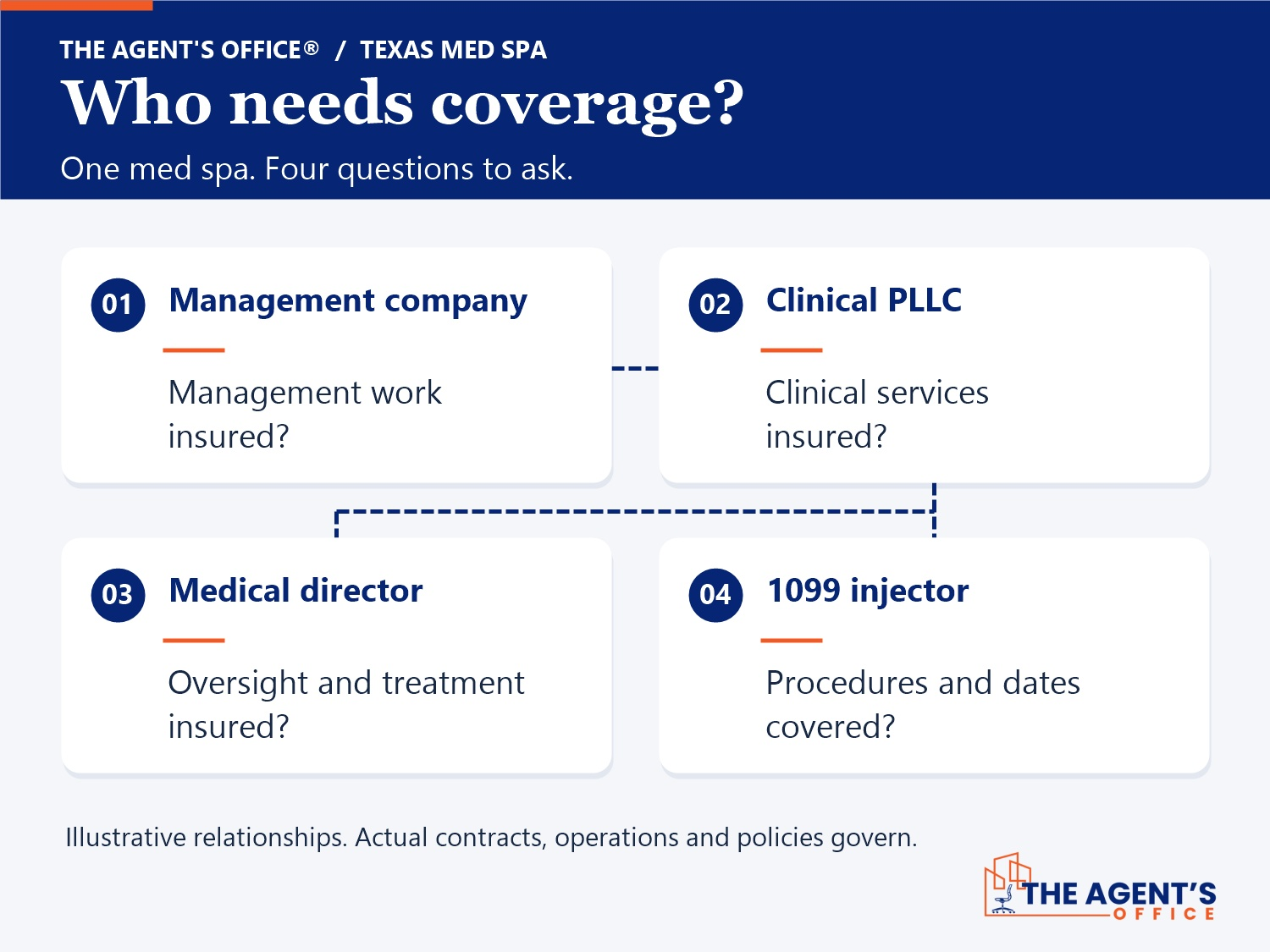
For the management company, check its management work; for the clinical PLLC, its services; for the medical director, oversight and any treatment; and for the injector, the procedures and dates. These are questions for review, not coverage conclusions.
| Participant | Question to resolve |
|---|---|
| Management services organization | Is the exact MSO insured for its own management activities and alleged liability arising from another party’s work? |
| Clinical PLLC | Does the policy address the entity, its professional services, locations and provider relationships? |
| Physician owner | Is the physician insured individually, for which activities and in which capacity? |
| Contracted medical director | Are the actual oversight duties and any direct patient care addressed? |
| Independent nurse injector | Is the individual insured for direct allegations involving the procedure, location and dates? |
| Individual MSO owner | Does the person have potential exposure in an individual capacity, and does any policy address that capacity? |
List exact legal names, DBAs and individual names. Then compare them with the declarations, definitions, practitioner schedules and endorsements. Ask the agent or insurer to identify the relevant provision when the answer is unclear. A proposal can guide the conversation, but review the policy actually issued.
The Texas structure is a legal question as well as an insurance question
The Texas Medical Board’s nonsurgical medical cosmetic procedures guidance identifies injections of medication or substances for cosmetic purposes among procedures it regards as the practice of medicine and discusses delegation. Whether a particular person may perform a procedure, and under what arrangement, depends on the applicable law, rules and facts.
Insurance does not validate an MSO structure. A quote, a policy or an insurer’s acceptance of an application does not establish that ownership, management, compensation, clinical control or delegation complies with Texas requirements. Ask Texas healthcare counsel to review the actual structure and contracts; consult the appropriate licensing professionals about clinical scope and responsibilities. Describe the confirmed operations accurately to the insurance agent and insurer.
Separate the physician owner from the medical director
If one physician owns the PLLC and a different physician serves as director, identify both. If one physician performs both roles, describe both. A physician’s individual patient-care policy should not be assumed to include every supervisory, administrative, entity or medical-director exposure. Likewise, a director endorsement should not be assumed to cover separate hands-on treatment. Compare the duties and services disclosed with the actual coverage forms.
Our Texas med spa medical-director article explores oversight in more detail. This guide adds the connected MSO, PLLC and contractor questions.
When an owner wears more than one hat
The individual who owns the management company might negotiate the lease, hire administrative staff and make marketing decisions. The same person might also own an interest in another entity or provide services personally. These are separate facts to describe in the application and review with counsel. The policy question is not simply whether “the owner” appears somewhere in the paperwork; it is how the policy defines an insured and what conduct it addresses in the capacity involved.
For a hypothetical claim alleging a treatment error, a complaint might focus on the injector, the clinical entity or others depending on the alleged facts. If the owner is also named for a separate alleged act, provide that allegation to the insurer or agent with the applicable policy information. Do not assume that an entity policy covers every personal allegation, or that being named in a complaint means the owner is legally liable. Defense and payment depend on the wording and facts.
Similarly, the clinical entity’s coverage and the individual practitioner’s coverage should be reviewed as distinct questions even when the same policy addresses both. Ask whether a shared limit applies, whether each person’s services fall within the described activities, and how any separate allegations are treated. These are requests for policy-specific answers, not a conclusion that separate limits are always available or necessary.
The MSO’s policy conversation may be different
The MSO in this example performs management services. It could be named in a demand depending on the allegations and facts. Do not assume that a commercial general liability policy addresses every allegation connected with professional services, or that the clinical policy includes the MSO. Ask the agent to compare the insured definitions, professional-services wording and endorsements under each relevant coverage part. Our malpractice and general liability comparison explains why the policies deserve separate review.
Five assumptions that can leave a gap in the review
1. “The injector is a 1099, so the policy decision is automatic.”
A tax classification does not itself establish policy coverage. Depending on the form, some contractors or scheduled practitioners may qualify as insureds and others may not. Individual coverage may also have restrictions. Read the definition of insured, practitioner schedule, services description, locations and endorsements. Ask how direct allegations against the injector and allegations against the clinical entity are addressed separately.
The contractual label also does not settle worker classification for tax or employment purposes. Have the appropriate professional review that issue independently.
2. “The injector has a certificate, so the business is covered.”
A certificate helps identify reported coverage, dates and limits. It does not replace the policy and endorsements. A certificate holder, an additional insured and a named insured are not interchangeable. Confirm the precise party, capacity and requested status in the actual forms. If two policies are relevant, do not assume their stated limits simply add together: defense, other-insurance terms, exclusions and facts can affect coordination.
3. “The management agreement transfers the risk.”
An indemnity provision is a contractual promise, not an insurance policy. Ask counsel what the agreement requires and ask the agent how the actual coverage addresses assumed obligations. A policy’s contractual-liability provisions and exclusions matter. Even a carefully drafted promise does not by itself establish that an insurer will pay it.
4. “The medical director is listed, so all physician activities are covered.”
Review the director’s actual duties, practice locations, delegated services and any direct treatment. Ask which activities were described to the insurer and how the policy treats changes. A physician beginning a new procedure or taking on another practice can create a different underwriting question. Obtain clarification before relying on an old description.
5. “The DBA on the certificate covers both companies and me.”
Named insured alignment begins with the correct legal identity and the policy wording. A trade name is not a substitute for a list of legal entities and individuals. Compare the legal name on the application, agreement, declarations and endorsements. Where the MSO, PLLC and individual owner differ, ask which exact party is insured and in what role. Do not assume a name on a certificate resolves a mismatch elsewhere.
Follow a hypothetical injection claim through the documents
Suppose the nurse performs an injection and a patient later alleges an injury. The demand names the injector and clinical PLLC and alleges that the director failed to supervise. In a separate version, it also names the MSO for alleged administrative conduct. These are examples of possible allegations, not predictions of what a court or insurer would decide.
The injector’s individual policy, the clinical practice’s policy, the director’s coverage and the MSO’s policies may have different definitions, limits and dates. One may address an allegation that another excludes, subject to the wording and facts. The practical first step is to identify all potentially applicable policies and follow their notice instructions with the agent’s help.
| Review question | Documents to examine |
|---|---|
| Who is insured, and in what capacity? | Declarations, definitions, provider schedules and endorsements. |
| Were the procedure and location disclosed? | Application, treatment menu, location schedule and applicable restrictions. |
| How are defense and limits handled? | Defense provisions, limits, deductibles or retentions, and aggregate terms. |
| When did treatment, claim and notice occur? | Policy periods, retroactive dates, reporting conditions and any extended reporting endorsement. |
| What did the parties agree to buy or provide? | Management, director and contractor agreements, reviewed alongside—not instead of—the policies. |
A displayed per-claim limit alone does not show that every defendant has a separate limit, or whether defense expenses reduce available limits. Ask whether providers and the entity share an aggregate, whether any retention applies and how defense expenses are treated. The answer must come from the particular policy.
Compare two possible arrangements on the same facts
Illustration A: one coordinated policy. The parties ask an insurer whether an issued professional liability form can include the clinical PLLC, qualifying practitioners and the medical director’s disclosed work. The review still needs to identify the MSO’s status, any work outside the described professional services, each individual’s capacity, limits, exclusions and policy dates. Even when names appear together, the actual provisions determine whether a particular allegation is addressed.
Illustration B: several policies. The PLLC, individual injector, medical director and MSO each present different policies or coverage parts. The practical task is to compare how the forms address names, work, dates and defense, including any other-insurance provisions. Similar-looking limits do not establish separate available limits for the same event. Differences in retroactive dates or exclusions can matter, and individual forms should be reviewed without assuming one fills every gap in another.
Neither illustration is a recommendation for a particular purchase, a representation that a carrier offers the arrangement, or an answer to a claim. Ask the agent to show the tradeoffs in writing, including what remains unresolved and what the insurer requires to consider a change.
When a practitioner leaves
Imagine the injector performed a treatment last year and leaves this month. A demand concerning that treatment arrives later. The Texas Department of Insurance’s medical liability guide explains the distinction between claims-made and occurrence coverage and the importance of continuity when changing coverage.
For any claims-made policy, review the treatment date, the policy’s retroactive date, when a claim is made and reported, and whether extended reporting or prior-acts coverage is available and suitable. The relevant requirements differ by policy. Do not assume the PLLC’s arrangement automatically preserves the departing injector’s or physician’s protection. Our claims-made and tail coverage guide explains the questions in greater detail.
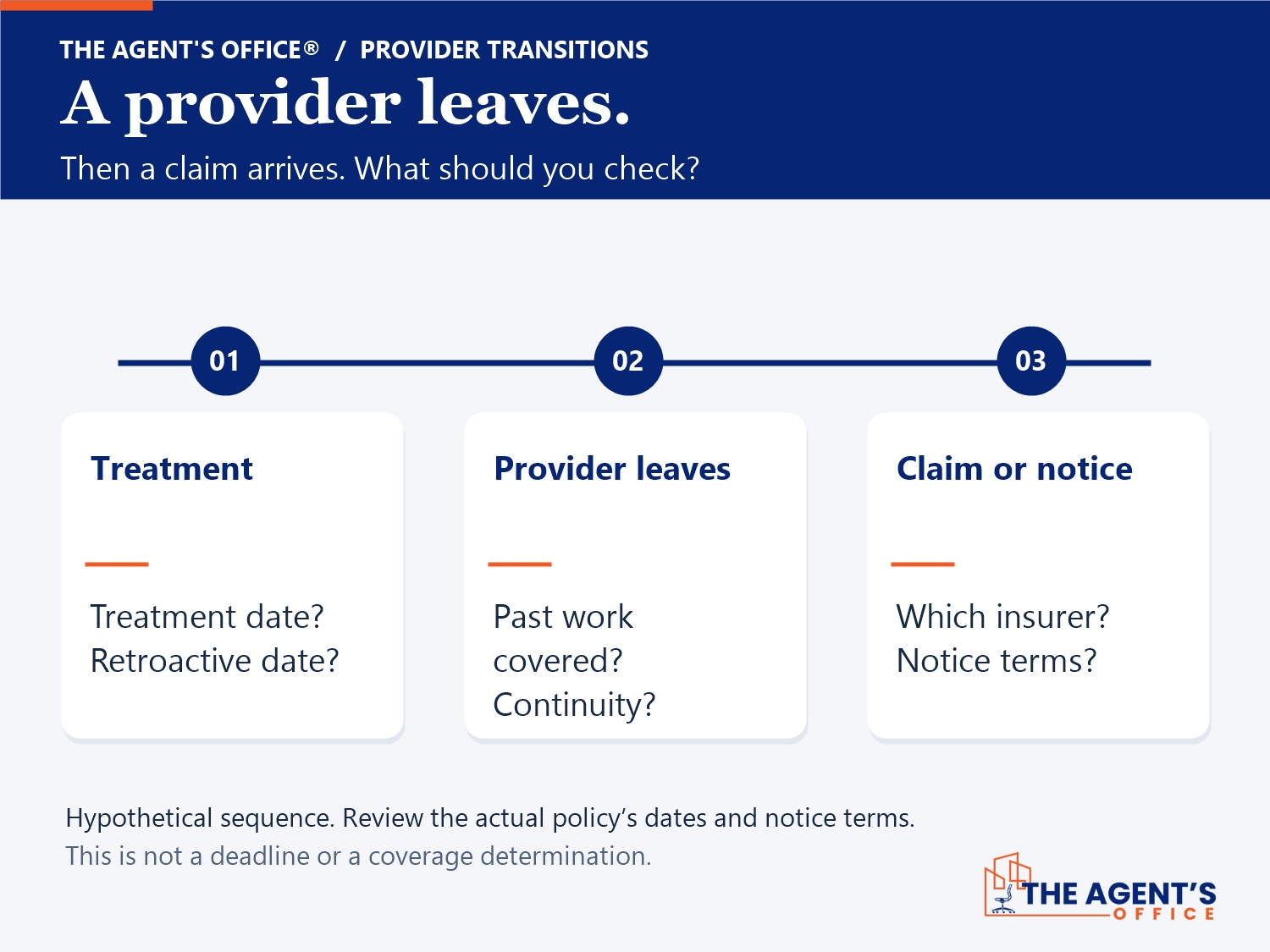
In this example, compare the treatment and retroactive dates, ask how past work is handled when the provider leaves, and review which insurer needs notice if a claim arrives.
Contracts may allocate who must obtain or pay for a reporting endorsement, subject to their wording. That allocation does not create the endorsement. Discuss changes before cancellation or expiration and confirm what the relevant insurer actually offers.
KEY FINDINGS (NOVEMBER 2026)
- The entity and the practitioner are separate questions. A 2026 review identified 20 selected jury-tried med spa cases indexed in Westlaw from 2006 through 2024: four named only the med spa, 15 only a practitioner and one both. This small, selected national sample is not a forecast for a Texas practice or a measure of coverage. It illustrates why both roles deserve attention. Rabin and colleagues, 2026.
- Filing may occur after a provider leaves. In a 2026 review of 46 selected U.S. civil cases involving aesthetic fillers from 1967–2025, the mean time from incident to filing was 2.4 years. The historical case sample is not Botox-only, representative of every claim or a reporting deadline. It is a reason to ask how the actual policy addresses prior acts and continuity. Le and colleagues, 2026.
- The defense can continue after filing. The same selected filler-litigation review reported a mean of 2.5 years from filing to final decision. This is not a prediction for your case, a measure of defense cost or proof that coverage applies. It prompts a separate question: how does the policy handle defense, limits and the aggregate during a claim? Le and colleagues, 2026.
Prepare an entity and liability coverage review
A useful review begins with accurate information, not a promise that a policy can be written in a particular way. Gather what you have and mark what remains unknown:
- Businesses: legal names, DBAs, ownership, locations and each organization’s actual role.
- People: physician owners, directors, employees and contractors, with duties, credentials and any other practice locations.
- Services: current and planned procedures, who performs them, and who oversees the clinical work.
- Agreements: management, director, contractor and lease documents for your legal and insurance advisors to review.
- Insurance: full policies, declarations, endorsements, schedules, limits, retroactive dates, expiration dates and relevant claims information.
- Changes: upcoming openings, new treatments, departures, entity changes and renewal dates.
Questions to put to the agent or insurer
When a review identifies an unclear provision, ask for the relevant policy wording and the facts the insurer used to evaluate the risk. Useful questions include:
- Which exact legal entities and individuals qualify as insureds under each coverage part, and does that status depend on a roster or endorsement?
- How does the form address a direct allegation against an individual as compared with an allegation against the practice arising from that person’s work?
- Does the description of services reflect every procedure and location that was disclosed? What happens if the practice adds a service or a provider?
- Are the entity and practitioners subject to a shared per-claim limit or aggregate? How do defense expenses and any deductible or retention apply?
- For claims-made coverage, which retroactive dates and reporting terms apply to each relevant person or entity? What options may be available if coverage ends?
- Which requests in the management, director and contractor agreements need a separate legal or underwriting answer?
Some answers may require the insurer to review the complete application, agreements or claims information. Record who provided the response and whether it refers to an application, an indication, a binder or the final policy. Ask for clarification when the issued documents differ from what was discussed. Neither an email summary nor an educational article changes the policy language.
This review can be especially useful when a practice is opening, an MSO is reorganizing, or a director and several contractors have coverage from different insurers. Repeat it when material facts change, rather than assuming the structure that fit at the last renewal still describes the current operation.
Before a renewal, opening or provider change
Make one person responsible for coordinating the information, while leaving legal, clinical and insurance judgments to the appropriate professionals. Send the agent a current list of legal entities, locations, procedures and providers. Note who is employed, who contracts with which party, who performs each service and whether any medical director also treats patients. Provide the actual contracts and insurance documents when requested; a brief roster alone cannot replace them.
For each change, ask what the existing policies require and when the insurer must be notified. A new injector, additional site, revised treatment menu, change in director or restructuring of an entity can change the facts the insurer needs to evaluate. Do not assume an old schedule automatically reflects a new arrangement. Confirm whether a requested change has been accepted and documented in the issued paperwork.
When someone leaves, assemble both the person’s own policy information and any practice policy that might be relevant. Record the dates of treatment, coverage and any retroactive date, and ask about reporting requirements and available continuity options before a policy expires or is canceled. If a contract assigns responsibility for an extended reporting endorsement, check both the legal obligation and whether the endorsement was actually obtained. Keep the relevant policy and endorsement records for future reference.
Finally, resolve outstanding questions with the right party. Counsel can interpret the business and contractual obligations; a licensing professional can address scope and delegation; the agent and insurer can help clarify the insurance wording. A written list of unresolved questions makes the next review more useful, even when the complete answer requires the final policy forms.
The Agent’s Office® can help organize the insurance questions and seek clarification from available markets where appropriate. Healthcare counsel and licensing professionals address the legal and clinical issues. No quote guarantees availability, a policy, defense or payment; the actual terms and facts govern.
For more practical coverage discussions, follow The Agent’s Office® on Facebook.
This article provides general educational insurance information. It is not legal, medical or compliance advice and does not determine coverage.
Ready to map your med spa’s coverage questions?
Tell us about your entities, professionals, procedures and current policies so we can discuss the information needed for a quote.
Request a Med Spa Entity & Liability Coverage Quote Call 972-696-9995Frequently asked questions
Can one policy insure my MSO, PLLC and injectors?
It may be possible for a policy or coordinated program to address multiple parties, subject to underwriting and the issued terms. Ask how each person and legal entity is insured, for what work and in which capacity.
Does a 1099 nurse injector need an individual policy?
It depends on the practice policy, individual work, contractual requirements and personal needs. The 1099 label alone does not establish insured status. Review the wording and discuss individual coverage with the agent and insurer.
Does the director’s personal policy cover the MSO?
Do not assume it does. Compare the insured definitions, covered capacity, services and endorsements with the allegations. Ask the insurer to identify the language addressing the MSO.
Is a certificate enough to prove coverage?
A certificate summarizes reported information but does not replace the policy and endorsements. Confirm the name, role, relevant services, term and any requested insured status in the actual forms.
Who buys tail coverage if a practitioner leaves?
That depends on the contract, policy and available coverage arrangement. Ask whether an extended reporting period is available, what it applies to, who pays and whether prior-acts coverage is offered elsewhere.
Does malpractice insurance make the MSO structure legal?
Insurance and legal compliance are separate questions. Texas healthcare counsel and appropriate licensing professionals should evaluate the actual ownership, agreements, operations and delegation.
You might also like:


George Azide
LOCAL, INDEPENDENT AGENCY
Want a coverage review?