

MEDICAL & AESTHETICS · TEXAS BUYING GUIDE
Med Spa Malpractice Insurance Cost in Texas: How to Compare Quotes
Understand what goes into the price, compare the protection behind it, and prepare a quote request that describes the practice you actually run.
TL;DR FOR BUSY PEOPLE
A useful med spa malpractice quote starts with your treatment menu, business entity, provider roles and requested coverage. Compare those details alongside the premium: the same stated limit does not establish that two proposals insure the same work, people or reporting period.
FAST ANSWER
- How much does it cost? Your price requires an insurer’s quote for your practice and requested terms. Ask for the annual premium, applicable taxes and fees, and any installment or financing charges separately. This guide does not establish a representative Texas average.
- What should you compare? Insured parties, procedures, limits, exclusions, defense provisions, retained amounts, policy dates and the complete payment breakdown.
- What comes next? Use the comparison table below, flag missing answers and request clarification before making a binding decision.
Two proposals. One decision.
Imagine this: you are closing the consultation office after a full day, and two insurance proposals are open beside tomorrow’s appointment book. One price is lower. Both summaries show a familiar liability limit. You would like to decide, clear the desk and get back to running the business.
This is a hypothetical scene, but the decision deserves a real method. A price is useful only when you know what was priced. Think of comparing treatment plans: a shorter total tells you very little until you understand what is included, who performs the work and what happens afterward.
For med spa owners in Frisco, Plano and McKinney, that comparison begins with describing the same practice to each insurer. Our med spa insurance program page is the place to begin a quote discussion. This guide helps you prepare for it.
This is general insurance education. The issued policy, endorsements and circumstances determine coverage; medical authority and legal obligations require separate professional review.
What goes into med spa malpractice insurance cost?
Start by asking what the price represents. Medical malpractice insurance, also called medical professional liability, addresses allegations arising from professional care according to its terms. It is not a name for every policy a medical business may need. The Texas Department of Insurance’s medical liability shopping guide explains the basic distinction between occurrence and claims-made coverage and the care needed when changing insurers.
A proposal might show malpractice separately, combine several coverages, or list optional additions. Before comparing totals, identify the coverage parts included in each. A business owners policy and a malpractice proposal are not interchangeable descriptions of the same purchase.
On a phone, swipe the table sideways to see every column.
| Part of the discussion | Question to ask |
|---|---|
| Professional liability | Whose professional services and which procedures are addressed by the proposed wording? |
| Other business coverages | Are general liability, property, cyber or employee-related coverages included, optional or separate? |
| Amount due | What are the premium, applicable taxes and fees, and any installment or financing charges? |
Why the practice description matters
Build the submission around your current and planned treatments, devices, actual and projected revenue, locations, provider credentials, medical direction and loss history. Include existing coverage and the dates you want reviewed. These are details to disclose accurately, not a formula that lets anyone calculate your premium from a website.
A new practice should identify projections as projections. An established practice should explain planned changes rather than submitting last year’s description unchanged. If you are adding a service, ask how that proposed work affects eligibility, price and terms before treating patients under an assumption.
That does not mean every added procedure raises a premium or every insurer asks identical questions. Ask what information the particular insurer needs and what its quoted price assumes. Keep a dated copy of the submission so you can check that the proposals respond to the same facts.
Avoid turning an advertised starting price into your budget
A price advertised elsewhere may describe a different practice, limit, jurisdiction or package. Without those details, it cannot establish what your Texas med spa will pay. This guide does not present a representative statewide premium survey, and it would be misleading to manufacture an average from unrelated offers.
The useful next step is a written quote for your circumstances, with enough detail to understand the figure. Ask for the annual amount and the complete payment schedule. If the proposal shows installments, check whether their total includes charges beyond the annual premium. Monthly affordability and annual cost answer different questions.
Keep the price discussion specific. Ask whether a quoted amount is final or subject to outstanding underwriting information, what period it covers and how long the proposal remains available. If you request a change to a limit or service description, obtain a revised proposal rather than comparing the original price with the revised scope in your memory.
Compare two proposals before comparing the price
Use this table with the proposals in front of you. For each row, record the answer from both documents and the page or endorsement supporting it. “Not stated” is a reason to ask a question. It is not another way of saying “covered.”
This is a comparison framework, not a substitute for the complete policy. A proposal can summarize terms without reproducing every definition, exclusion and condition. Request the wording and forms relevant to an unresolved issue, and ask for clarification in writing.
On a phone, swipe the table sideways to see every column.
| Compare | What to record for each quote | What needs confirmation? |
|---|---|---|
| Business and insurer | Insurer name, legal business name, DBA and locations. | Does the proposed insured match the entity doing the work? |
| People and roles | Practitioners, employment/contract arrangements and medical-director duties. | Who is insured, in what capacity, and under which coverage part? |
| Services and devices | Current and planned procedures, equipment and restrictions. | Does the wording address the actual menu? What is excluded? |
| Limits | Per-claim limit, aggregate and relevant sublimits. | Are limits shared, separate or subject to other provisions? |
| Defense provisions | How defense expenses affect limits and retained amounts. | Which wording governs defense and settlement decisions? |
| Deductible or retention | Amount, application and responsibility for handling expenses. | What must the insured pay, and when? |
| Coverage dates | Policy term, trigger, retroactive date and reporting requirements. | What happens to earlier services if you change coverage? |
| Conditions and exclusions | Material restrictions and endorsements. | What important question remains unanswered? |
| Payment terms | Premium, applicable taxes/fees and installment details. | Are you comparing annual totals and the same included coverages? |
| Before binding | Outstanding information, quote validity and requested effective date. | What is still required before coverage can be confirmed? |
You do not have to become a policy specialist to use the table. Your job is to identify the practice you run and the questions you need answered. The agent and insurer should explain the proposed terms; legal interpretation may require counsel. Keep unresolved items visible instead of allowing the premium line to close the conversation.
A request you can send with your proposals
Use this wording to move an unclear comparison forward. Replace the brackets with your practice details; keep patient records out of an ordinary email.
Please compare these proposals using the same practice information: [legal entity and DBA], [locations], [providers and roles], and [current and planned procedures/devices]. Please identify differences in insured parties, procedure restrictions, limits, defense provisions, retained amounts and coverage dates. Show the annual premium, applicable taxes and fees, and installment or financing charges separately. For each unresolved item, please point me to the relevant wording or endorsement. Please also identify anything still required before binding.
Give defense and retained amounts their own conversation
Ask the agent to walk through the defense provision using the proposed wording. Do defense expenses reduce the stated liability limit? Do they apply toward a deductible or retention? Who selects counsel, and what authority does the policy give the insurer and insured in settlement decisions? Record the answers without assuming that the arrangement on your current policy follows you to another one.
Then ask what would be required from the business if a covered claim triggered the retained amount. A deductible and a self-insured retention should not be treated as interchangeable simply because each has a dollar figure beside it. The actual provision controls. An attractive premium becomes more meaningful when the owner also understands the cash obligation and claims-handling responsibility being accepted.
Three anchors keep the comparison useful
Services: give each quoting insurer the same treatment and device list. People: describe the business and practitioners consistently. Terms: request comparable limits and dates, then identify differences the insurer actually offers. Asking for the same terms does not establish that both proposals provide them.
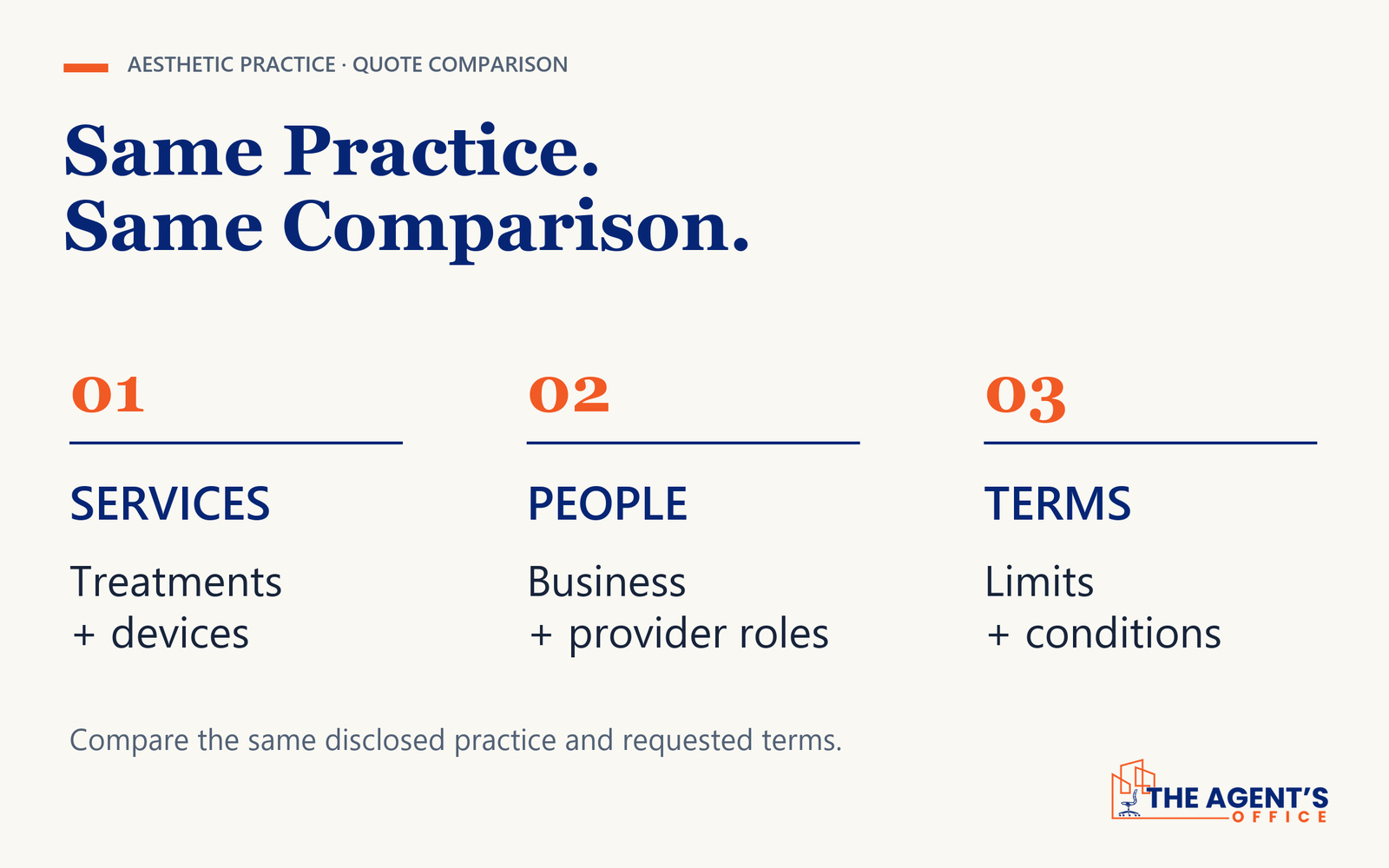
The named-insured alignment question belongs here: the trading name on a sign, the legal entity and an individual practitioner are not simply interchangeable labels. Ask how each relevant party appears in the proposed coverage.
Work through a hypothetical quote comparison
Suppose a med spa offers injectables and laser treatments. Its owner wants to compare a renewal with another proposal. The following is an educational illustration, not an actual offer, insurer form or coverage determination.
Assume both summaries display the same liability limit. Proposal A describes the submitted service menu, identifies the business and listed providers, and shows the prior-acts date the owner requested. Proposal B excludes laser work, identifies the entity only and shows a later starting date. Every one of those assumptions would need confirmation in a real comparison.
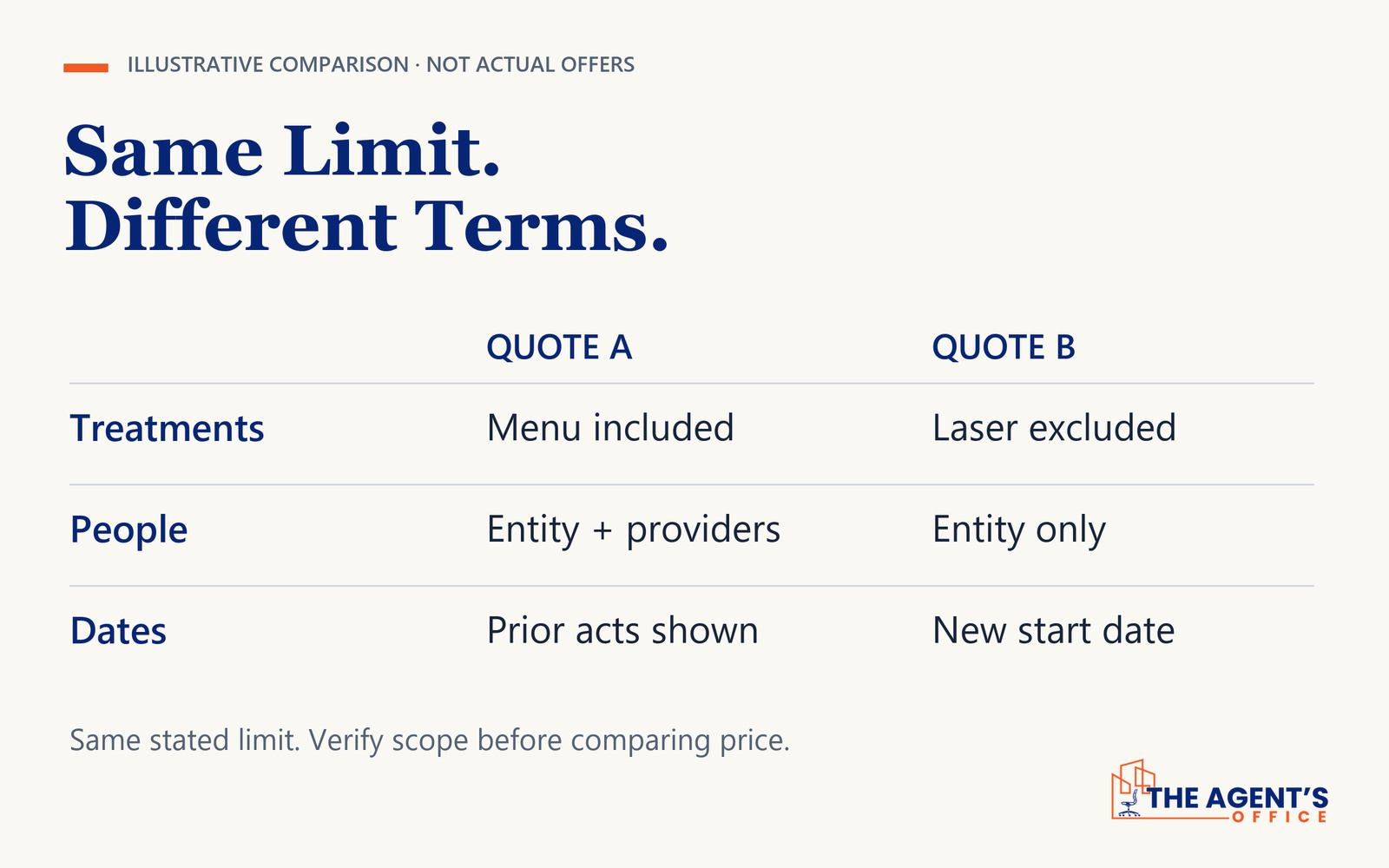
Even if Proposal B costs less, the owner has not yet compared the same purchase. The next question is whether its scope can be changed, whether separate coverage addresses the differences, or whether another option needs review. The table does not make Proposal A the automatic winner either: exclusions, conditions and other material terms still matter.
Compare the financial tradeoff explicitly
Here is a separate arithmetic example. Assume one proposal saves $600 per year but increases a particular retained amount from $1,000 to $5,000, with all other relevant terms assumed equal solely for this illustration. The additional retained amount is $4,000. Dividing $4,000 by $600 gives approximately 6.7 years of assumed savings.
That calculation is not a forecast, a recommendation or a premium estimate. A claim could arrive before savings accumulate. The retention could apply differently than assumed, and other provisions may change the comparison. Use actual wording and an amount your business could fund; do not turn a simple division into a promise that accepting more risk will pay off.
Do not add unlike costs into a misleading total
The premium and applicable purchase charges are one category. A deductible or retention may become relevant under the policy when a claim arises. A tail or prior-acts discussion concerns continuity when coverage changes. These amounts have different conditions and timing; they are not automatically three bills due every year.
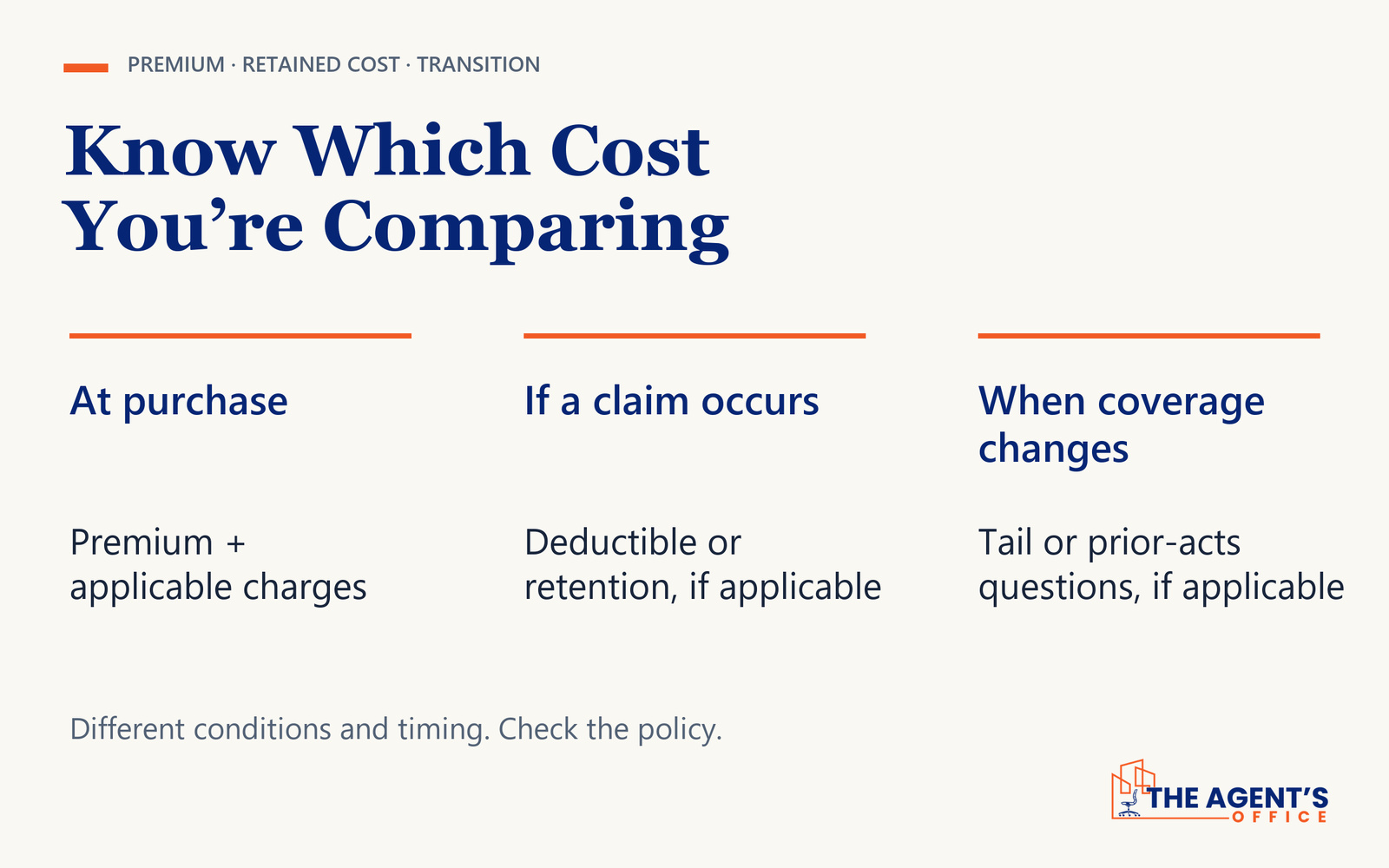
For the timing mechanics, read our claims-made, occurrence and tail coverage guide. Then verify the retroactive date and reporting provisions on your own documents. Do not cancel an existing policy because a new quote has arrived.
Check the Texas practice details behind the quote
The Texas Medical Board identifies specified nonsurgical medical cosmetic procedures as the practice of medicine and refers readers to its delegation rules. That is a separate question from whether a policy insures a procedure or a person. Buying insurance does not establish authority to perform or delegate treatment.
Provide the medical-director arrangement, the work actually performed and the credentials and roles of treating providers. Ask about direct treatment and supervisory responsibilities separately. For a deeper discussion, use our existing med spa medical-director liability guide; do not assume that naming a physician settles the entity’s insurance question.
Make the people review concrete. List each role beside the work that person performs and the business relationship involved. An owner who treats patients, a physician providing medical direction and a contracted practitioner may prompt different questions. Ask which proposed provision addresses each role; a job title or payment classification alone is not the answer.
If the practice changes staff, locations or services during the year, ask what notice and underwriting review the policy requires. Keep the service menu and provider roster current enough to explain those changes. This is useful preparation for an insurance conversation, not a declaration that completing a roster satisfies licensing rules or guarantees protection.
Laser hair removal also warrants checking the applicable Texas Department of Licensing and Regulation requirements. Its official forms page includes facility registration and a sample consulting-physician contract. Avoid treating every device, procedure or physician relationship as subject to the same regulatory arrangement.
Keep treatment liability and business accidents distinct
Ask which coverage part addresses an allegation about professional care and which addresses other business exposures. Our malpractice versus general liability guide develops that distinction. For a specific event, labels alone cannot decide coverage; the allegations, policy definitions, exclusions and conditions matter.
A lease, equipment agreement or other contract may add requirements to the purchasing discussion. Bring the actual document rather than reporting only that the landlord “needs a million.” Ask which entity, coverage, limit and evidence the contract requests. Whether the policy satisfies that legal obligation may need a separate contract review.
Read research as evidence, not a price calculator
The findings below illuminate three comparison questions: whose interests need review, why defense provisions deserve attention, and why the precise procedure matters. They come from selected historical legal cases, not a representative survey of Texas med spas. They do not measure claim probability, treatment safety, typical premiums or the outcome of your own claim.
KEY FINDINGS (NOVEMBER 2026)
- Whose coverage should be compared? A 2026 study of 20 Westlaw-indexed med spa jury cases dated May 2006–October 2024 found four naming only the spa, 15 only a practitioner and one both. Rabin and colleagues. Small selected sample; not the distribution of all claims.
- Why inspect defense terms? Defendants won seven of those 20 cases (35%). That is a litigation outcome in the selected sample, not a measure of defense expense or the likelihood of winning. It prompts a separate question about how the proposal handles defending a claim. 2026 study.
- Why specify the exact procedure? A 2019 study searching legal databases from 1985 to the study period found alleged burns/scarring in 90% of its 20 laser-resurfacing cases. This describes historical selected litigation, not 90% of treatments or current Texas risk. Medical Malpractice Claims After Nonsurgical Cosmetic Procedures.
Prepare a useful quote request with The Agent’s Office®
Begin with one accurate description of the practice. Gather the legal entity and DBA, locations, current and planned services, devices, provider roster and roles, medical-director agreement, revenue information, current policies and requested effective date. Identify projections and anything still being confirmed.
Add loss runs when requested and tell the agent about relevant claims, incidents or circumstances the application asks you to disclose. Do not decide privately that a matter is too small to mention. If you do not understand a question, ask before signing. Be careful with patient information; use the secure process the agent or insurer provides for any documents that require it.
The Agent’s Office® can help organize that discussion, seek options for the submitted practice and explain important proposed differences. Start with what you have. The objective is a clearer insurance decision, supported by written information—not an assumption that every insurer, procedure or practitioner will qualify.
A practical sequence before you commit
- Describe the practice once. Keep a dated service menu and provider list for the comparison.
- Complete the comparison. Record the actual terms and identify unanswered questions.
- Resolve the important differences. Request wording or written clarification; obtain legal or medical advice where the issue requires it.
- Coordinate the transition. Confirm binding requirements and effective dates, and address prior-acts/reporting questions before changing existing coverage.
Count the cost of the commitment
Luke 14:28 says, in the KJV, “For which of you, intending to build a tower, sitteth not down first, and counteth the cost, whether he have sufficient to finish it?” Jesus is speaking about discipleship. A modest stewardship application is to understand a commitment before making it; the verse does not prescribe an insurance product or limit.
Proverbs 18:13 adds, “He that answereth a matter before he heareth it, it is folly and shame unto him.” Hear the details behind a proposal before answering its price. Ask the question, read the response and keep the decision grounded in what is actually offered.
For more practical insurance resources, like The Agent’s Office® on Facebook.
Ready to compare options for your med spa?
Tell us about your treatments, team and timeline. Already comparing proposals? Tell us which service, provider or policy date needs clarification. The Agent’s Office® can help organize those questions and discuss the proposed terms. Requesting a quote does not bind insurance.
FAQs about med spa insurance cost
How much does med spa malpractice insurance cost in Texas?
Obtain a quote based on your actual services, providers, business and requested terms. Ask for the annual premium, applicable taxes and fees, and any installment or financing charges separately. This guide does not establish a representative Texas average.
Is the malpractice premium my total med spa insurance cost?
Not necessarily. Check whether the proposal includes other coverages and whether taxes, fees or installment charges are shown separately. General liability, property, cyber and employee-related coverages require their own review.
Why can two med spa insurance quotes have different prices?
They may respond to different submitted facts or offer different insured parties, procedures, limits, exclusions, retained amounts or dates. Use the same practice description and compare the actual terms before attributing the difference to price alone.
Does the same liability limit mean the same coverage?
No. A displayed limit does not establish which services or people are insured, what is excluded, how defense expenses are treated or which claims fall within the coverage dates. Read the applicable wording and endorsements.
What should I check before switching a claims-made policy?
Review the retroactive date, prior-acts treatment, reporting duties, available tail options and the timing of both policies. Ask the agent and insurer how continuity will be addressed before canceling existing coverage.
Does a medical director’s policy automatically insure the med spa?
Do not assume it does. Review the insured entities and individuals, their capacities, covered professional services and applicable restrictions. A practitioner’s separate policy is not by itself evidence of the business’s coverage.
Can I request a quote before every detail is ready?
You can begin a conversation with the information available and clearly identify what remains outstanding. The insurer may require additional documents before quoting or binding. Keep estimates labeled and confirm requested information before signing.
You might also like:

Med Spa Insurance in Texas: Medical Director Liability
Review the people and professional roles behind the treatment menu.

Malpractice vs. General Liability
Understand the different coverage questions a practice should ask.

Claims-Made, Occurrence and Tail Coverage
Consider how coverage dates affect a change of insurer.

George Azide
LOCAL, INDEPENDENT AGENCY
Want a smarter quote?