

MEDICAL PROFESSIONAL LIABILITY · TEXAS
Does Your Employer’s Malpractice Insurance Cover You as a Nurse Practitioner in Texas?
Check who is insured, which work is described, and what happens when an arrangement changes.
TL;DR FOR BUSY PEOPLE
Your employer’s malpractice arrangement may cover you for your work, but the answer depends on the actual policy, endorsements and facts. Verify the insured person and capacity, services, locations, limits, defense provisions and reporting terms. A separate policy may be useful in some situations; it is not automatically necessary or automatically additive.
FAST ANSWER
- Does an employer policy cover me? It may. Ask the risk manager or responsible insurer or agent how the actual wording applies to your role.
- Does a license settle coverage? No. Clinical scope, physician delegation where applicable, and insurance are separate questions.
- What if I change jobs or work elsewhere? Review the applicable work and reporting terms before the change; a group policy may continue, and tail or prior-acts arrangements may be relevant if coverage changes.
One clinician, two calendars, two coverage questions
Imagine an NP finishing a weekday clinic schedule and considering occasional weekend work for a separate aesthetic practice. The employer’s benefits page says malpractice coverage is provided. The new clinic’s agreement mentions insurance too. Neither sentence alone explains whether the same person is insured for both sets of services or what happens when one arrangement ends.
This is a hypothetical situation, not a client story. The questions matter in Frisco, Plano, McKinney, Little Elm and throughout Texas. Our medical practice insurance resource offers the broader practice perspective; this guide starts with the clinician’s own questions.
This is general insurance education. The issued policy, endorsements, contracts and facts control any coverage determination. An attorney can advise on legal and contract questions, while the insurer or licensed agent can explain policy terms. Clinical and licensing questions require the appropriate authorities and qualified clinical advisers.
How can a nurse practitioner verify employer malpractice coverage?
Start with the arrangement your employer actually has. Medical malpractice insurance, also called medical professional liability insurance, concerns allegations arising from professional healthcare services, subject to its terms. Employers use different arrangements, including insurance issued to a practice or group and, in some settings, other risk-financing arrangements. Ask the person responsible for risk management what documents apply and who can answer questions about them.
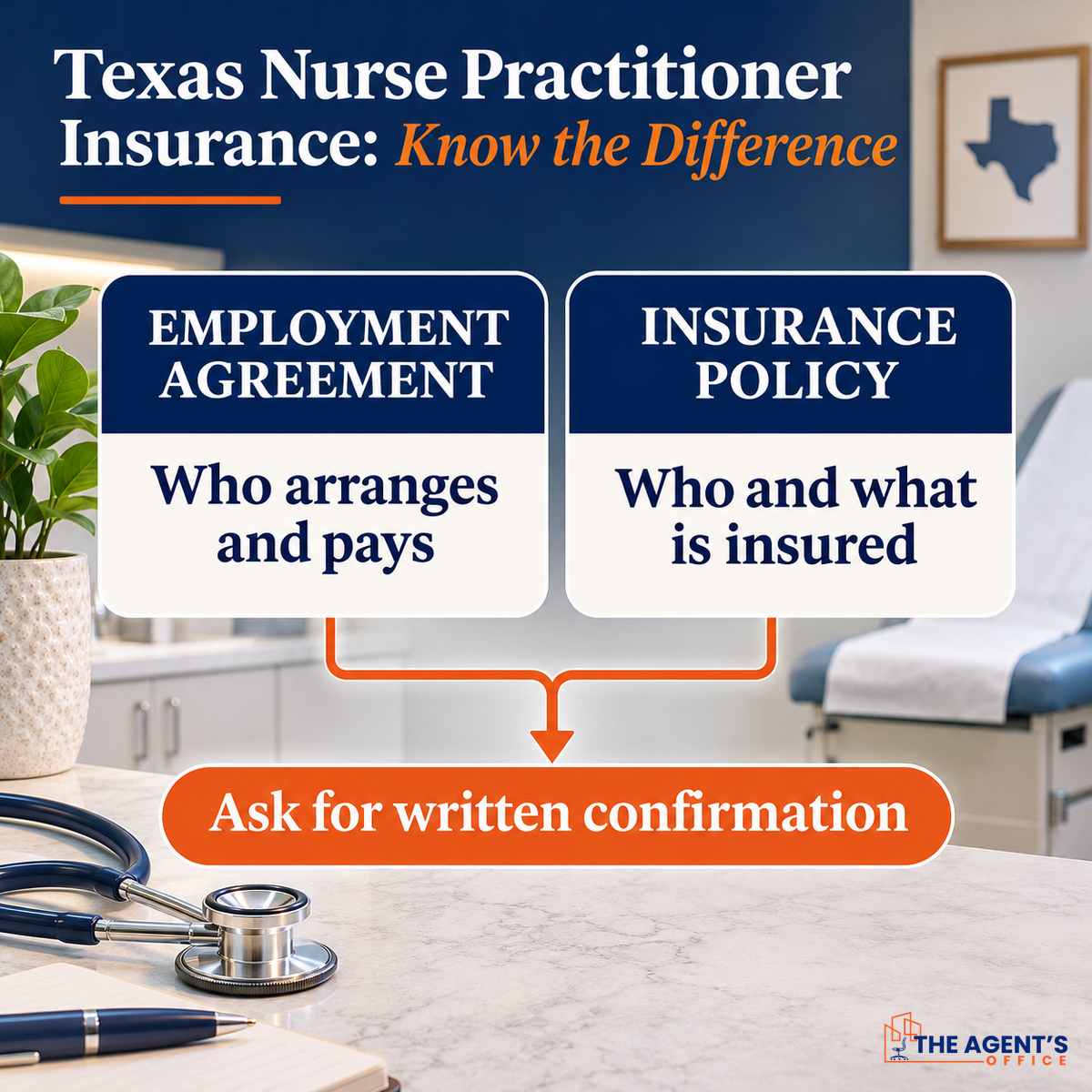
An employment contract and an insurance policy do different jobs. The agreement may state who must arrange or pay for protection. The policy, declarations, schedules and endorsements describe the insured parties, professional services, limits, exclusions, conditions and reporting requirements. A promise to buy insurance does not itself amend a policy or prove that the promised insurance was obtained.
Ask whether you qualify as an insured
Look for the named insured, the definition of “insured,” and any clinician roster or endorsement. A person does not necessarily have to be individually named on the declarations to qualify: a form may define insured people by a class or role. Equally, the employer’s name on a document does not prove that every clinician, activity or entity is insured. Ask for an explanation tied to your work and the actual wording.
A certificate of insurance can help identify the insurer, policy period and stated limits. It is a useful lead, not the whole policy. The Texas Department of Insurance certificate FAQ explains that Texas law does not prohibit an agent or insurer from providing a copy of the policy or endorsements. Ask the employer for relevant materials or a way to obtain them, then keep the version and written explanations that apply to your employment.
On a phone, swipe across the table to see each column.
| Start here | Question to resolve | What to retain |
|---|---|---|
| Employment agreement | Who arranges and pays for coverage and any departure obligation? | Signed agreement and insurance provisions. |
| Declarations and certificate | Which insurer, dates and stated limits are shown? | Current certificate and declarations, if available. |
| Policy and endorsements | How are insured people, services, exclusions and reporting defined? | Relevant forms, schedules and endorsements. |
| Risk manager or insurer | How do the terms apply to this role, setting and work? | Dated written clarification and contact details. |
If access to the full group policy is limited, do not fill gaps from memory. Request the applicable insured-person wording and a written response to specific questions. Ask who to contact if a claim, incident or board matter arises. Keep the response with the documents. It is not a substitute for the policy or a guarantee of a later decision.
Read the limits with the defense terms
A per-claim figure and an aggregate answer different questions. Ask whether limits are shared among insureds or provided separately, whether defense expenses affect the limit, and whether a deductible or self-insured retention applies and to whom. The shared versus separate limits explanation defines that distinction. A large figure on a certificate cannot settle every question about allocation, exclusions or defense.
Also ask how the arrangement addresses a licensing-board investigation or subpoena. Civil malpractice defense and a board matter are different questions. A policy may provide a separate benefit, impose a sublimit or condition, or not provide that benefit. Ask what event triggers any protection and whether representation, reimbursement and expenses are addressed.
Does the answer change with a clinic, telehealth or med spa shift in Texas?
It can. First identify whose work you perform and in what capacity. An employer arrangement might apply to services performed on the employer’s behalf and may address other work only if its wording does so. A second facility may arrange its own coverage, but its policy might address the facility, the clinician, both or another combination. Ask each party responsible for the relevant policy rather than assuming a building, paycheck or job title settles the issue.
Describe the entity engaging you, whether you are an employee or contractor for that assignment, the location, patient population, hours, procedures, telehealth activities and any supervisory duties. Tell the responsible agent or insurer when those facts change. The policy’s professional-services definition, schedules, conditions and exclusions must be read together.
The Texas Board of Nursing’s APRN scope guidance explains that individual scope depends on role, population focus, education and other factors. The Board’s APRN practice FAQ discusses cosmetic procedures and applicable physician delegation. A permitted clinical activity and an insured activity are separate determinations. Verify the first with appropriate clinical and legal authorities and the second under the applicable insurance arrangement.
On a phone, swipe across the table to see each column.
| Illustrative work | What to describe | Question to ask |
|---|---|---|
| Regular employer’s clinic | Role, employer and professional services. | How does the policy define insured employees and capacity? |
| Another clinic or weekend shift | Separate contracting party, location and duties. | Which arrangement, if any, addresses this assignment? |
| Med spa work | Actual procedures, products, setting and entity. | Do the applicable terms address these activities and this clinician? |
| Telehealth or administrative work | Where services are delivered and the precise duties. | How do the definitions, territory and restrictions apply? |
These are questions to investigate, not findings that any example is covered or excluded. If you have a clinician-owned entity, ask separately whether it is insured and for which activities. If a practice changes its treatment menu, tell the responsible agent what is changing. Our Texas med spa quote-comparison guide explains why provider roles and treatment details matter when a practice seeks proposals.
For telehealth, clarify whether work is performed on the employer’s behalf and identify relevant jurisdictions and services. Licensure, clinical rules and policy territory are distinct questions. A policy purchased for one set of facts should not be assumed to follow every new arrangement. Equally, do not assume a separate shift is excluded without examining the wording.
Five assumptions worth checking before you rely on coverage
- “I am employed, so I am covered for every service.” Employment is important; insured status and scope still depend on the arrangement. Verify the role, entity and activities.
- “If my name is not on the declarations, I cannot be insured.” Some policies define insureds by category. Ask for the applicable definition and how it applies.
- “The certificate settles every detail.” It summarizes selected information. Read the policy and endorsements, including exclusions, defense and reporting provisions.
- “A personal policy automatically adds its limit to my employer’s.” Other-insurance, primary and excess provisions may affect how policies interact. Ask the responsible insurers or agents to explain the wording; do not simply add limits and assume the total is available.
- “A board complaint is handled exactly like a patient lawsuit.” Ask separately about professional liability, license defense and other benefits, including triggers, limits and conditions.
Is buying an individual policy always necessary?
There is no universal answer. An employer’s arrangement may address the work and terms the clinician needs to review, or a separate policy may address a different assignment or benefit. An individual policy can also have exclusions, limits, eligibility conditions and other-insurance wording. It does not automatically cure an excluded activity, replace an employer’s obligations or provide independent counsel for every situation.
Compare the actual documents and work they describe. If you request a quote, disclose existing insurance and each activity accurately. Ask whether the proposed policy is primary or excess in the relevant circumstances, what legal representation provisions apply, how board matters are handled and whether proposed dates and services match your needs. An agent can help organize the comparison; the insurer decides eligibility and the issued policy governs.
The distinction between professional and premises exposures also matters when you operate a practice. Our guide to malpractice and general liability for Texas practices explains why a patient-care allegation and an ordinary premises accident can raise different coverage questions. Do not assume either policy answers every possible claim.
What happens to claims-made coverage when an NP leaves a job?
Begin by identifying the form and asking what happens to the employer’s arrangement. The Texas Department of Insurance medical liability guide distinguishes occurrence and claims-made policies. In general, an occurrence form looks to when an event occurred; a claims-made form depends on the policy’s claim and reporting provisions as well as applicable dates. All other terms still matter.
Leaving a job does not automatically end the employer’s group policy. Ask whether the policy will continue, whether it continues to address your eligible prior services after departure, how future claims should be reported, and what happens if the arrangement later changes or ends. Obtain an answer in writing from the appropriate source. A group may have a different arrangement from an individual policy, and no reader should infer continuity solely from the fact that the business remains open.
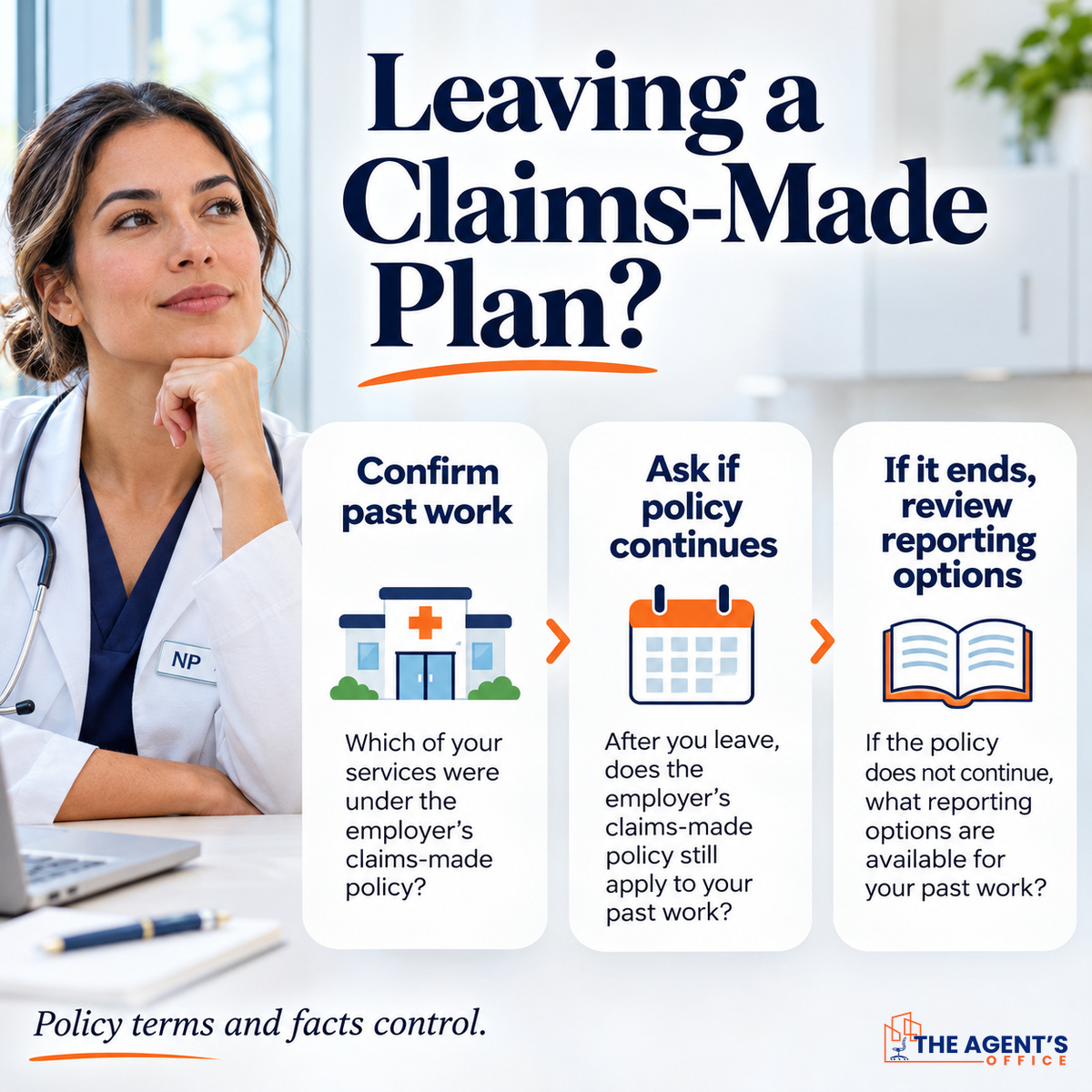
If a claims-made policy ends or the applicable arrangement changes, an extended reporting period, often called tail coverage, may permit reporting of eligible claims concerning earlier work under its terms. A new claims-made policy might offer prior-acts or “nose” coverage back to an accepted retroactive date. Neither option is automatic, and neither should be assumed to cover every earlier service. Ask about availability, cost, duration, election deadlines and how the new and old wording compare.
Tail generally addresses reporting for qualifying earlier acts; it is not insurance for new work performed after the old policy ends. The employment agreement may assign responsibility for arranging or paying for a reporting period, but both agreement and policy need review. Confirm what was actually purchased, keep proof and record the reporting contact. See our claims-made and tail guide and retroactive-date explanation for context; the particular policy’s terms control.
Compare a proposed individual policy on more than price
Ask for the premium and applicable taxes, fees or payment charges, then compare the coverage described. Review the form, retroactive date if applicable, insured person and entity, professional services, locations, limits, defense treatment, license-defense benefit, exclusions and reporting conditions. An advertised price for another state or specialty is not your quote. Pricing, markets and eligibility depend on submitted facts and insurer decisions.
Imagine two proposals with the same stated limit. One may describe work for a particular entity while another describes additional disclosed services. They could differ in defense provisions or how they interact with existing insurance. Those are hypothetical possibilities, not predictions about either policy. Ask for the actual wording and a side-by-side explanation before deciding which proposal, if any, fits.
The findings below address how some clinicians reported paying for insurance, why separate work deserves a question, and why reporting insurance is different from confirming its terms. None tells you whether your employer’s policy covers you.
KEY FINDINGS (NOVEMBER 2026)
- Who paid for coverage in one survey? In the Illinois Nursing Workforce Center’s 2024 voluntary survey of full-practice-authority APRNs, among respondents reporting malpractice insurance, 72% said the employer paid, 17% said they paid themselves, and 12% reported shared cost. Its 2025 report describes 793 respondents and a 24% overall response rate; rounded percentages need not total 100%. This Illinois group is not a Texas NP estimate, and who pays does not establish scope. Illinois Nursing Workforce Center report.
- Why ask about a second job? The same 2024 Illinois survey reports 21% of respondents worked a second job; 65 of 793 participants did not answer the positions question. The survey does not establish that each second job was clinical, uninsured or in Texas. It illustrates why a reader with separate work should identify the parties and ask which arrangement applies. Illinois Nursing Workforce Center report.
- Did respondents report having malpractice insurance? The Illinois Nursing Workforce Center’s 2024 survey reports that 98% of full-practice-authority APRN respondents had malpractice insurance. This voluntary Illinois survey is not a Texas NP estimate; reporting insurance does not establish its limits, covered work or adequacy. Ask for the applicable policy details rather than assuming those answers from a survey. Illinois Nursing Workforce Center report.
How The Agent’s Office® can help you prepare the conversation
Gather what you can: your agreement and insurance provisions; current declarations, policy wording, schedules and endorsements if available; the employer’s risk-manager contact; a description of each role and location; and questions about the end of an arrangement. If considering a separate policy, include existing coverage and the dates and activities you want reviewed. Start with what you have and identify missing documents rather than guessing.
As an independent agency in Frisco, The Agent’s Office® can discuss the facts you provide, help organize questions and seek available options where appropriate. Insurer interest, eligibility, price and terms depend on the work and underwriting. A conversation or quote request does not bind insurance, and no general article can decide whether a future claim will be covered.
The online healthcare form is designed around practices and businesses. If you are an employed NP seeking to discuss individual coverage and do not operate a practice, call 972-696-9995 to explain your situation and ask about the appropriate next step. Practice owners can also use the medical practice insurance page.
In Luke 14:28 (KJV), Jesus asks, “For which of you, intending to build a tower, sitteth not down first, and counteth the cost, whether he have sufficient to finish it?” The passage teaches about the cost of discipleship. As an analogy for stewardship, it invites thoughtful preparation before a commitment: gather facts, understand obligations and ask questions while there is still time to act. Scripture is not an insurance promise or evidence that a policy will respond.
For more practical coverage insights, like The Agent’s Office® on Facebook.
Ready to see your real options?
Bring your policy questions and the details of the work you want reviewed. Individual clinicians can call if the practice-focused form does not fit.
FAQs about nurse practitioner employer coverage
Does my name have to appear on the declarations page?
Not necessarily. A policy may identify insured people by category or role rather than name each person on the declarations. Ask for the applicable definition, schedules and endorsements and how they apply to your work.
Does employer coverage follow me to a separate med spa?
It may or may not. Identify the employer or contracting entity, the procedures and location, then ask the responsible insurer or agent how each relevant policy applies. Do not assume the first employer’s policy or the med spa’s policy includes the separate work.
Do I always need to buy tail coverage when I leave?
No. First determine what happens to the employer’s claims-made arrangement and whether it continues to address your eligible prior work. If it ends or changes, ask about available reporting options, contractual responsibilities, cost and deadlines.
Will an individual policy automatically add to my employer’s limits?
Not automatically. The policies’ other-insurance provisions, limits, exclusions and facts affect how they may interact. Ask the responsible insurers or agents to explain the actual terms before assuming the limits can be added.
Does malpractice coverage pay for a nursing board complaint?
It depends on the arrangement and the proceeding. Ask specifically about any license-defense benefit, what triggers it, available limits, representation or reimbursement, exclusions and conditions.
What should I request before changing jobs?
Ask for your agreement, applicable policy information and reporting instructions, and a written explanation of how eligible prior work is addressed after departure. If a claims-made arrangement ends or changes, review reporting or prior-acts options and deadlines with the responsible parties.
You might also like:

Claims-Made, Occurrence and Tail Coverage
Explore timing questions behind a change in coverage.

Med Spa Malpractice Insurance Cost in Texas
Compare the people, procedures and terms behind a practice quote.

When Do Texas Physicians Need Malpractice Insurance?
See related review points from a physician perspective.

George Azide
LOCAL, INDEPENDENT AGENCY
Want a smarter quote?