
Medical Practice Insurance · Texas Med Spas
Does My Texas Med Spa Insurance Cover Facials and Injectables?
If your med spa offers facials, waxing and medical treatments, here’s how to check the services, providers and locations described in your issued coverage.
FAST ANSWER
One program may address both. Check the policy service by service.
A Texas med spa can have one package or coordinated policies that address esthetic and medical professional liability. Check whether the issued terms address each service, the business and people performing it, and the locations and dates involved.
- Compare facial and waxing services with the esthetic professional liability wording. Check injectables against the applicable medical professional liability terms.
- Read the professional-services definition and exclusions alongside any endorsements. Ask for a written answer on unresolved services before adding them to the booking calendar.
In this guide · Jump to a section

MAKE THIS GUIDE USEFUL TO YOU
Which situation brings you here?
Choose a situation to see suggested reading and add relevant questions to your review packet. The full guide stays available, and you can change your choice at any time.
Explore the full insurance guide
Use the guide in order or choose the situation that most closely matches your practice.
Plan the first injectable appointment
Describe the proposed treatment, location and people and ask which issued form addresses each.
- Which terms address this product, procedure and provider?
- What written change applies and on what date?
Review the policy against both sides of the menu
List services and staff, then compare current forms, exclusions and effective dates.
- Where does each service fall under the existing wording?
- What change since the last renewal needs review?
Describe what the service involves
Use the exact procedure, product and practitioner when asking licensing and insurance questions.
- What facts determine the regulatory classification?
- What policy language addresses how the treatment is actually performed?
Showing the general guide.
A single booking menu can raise different coverage questions
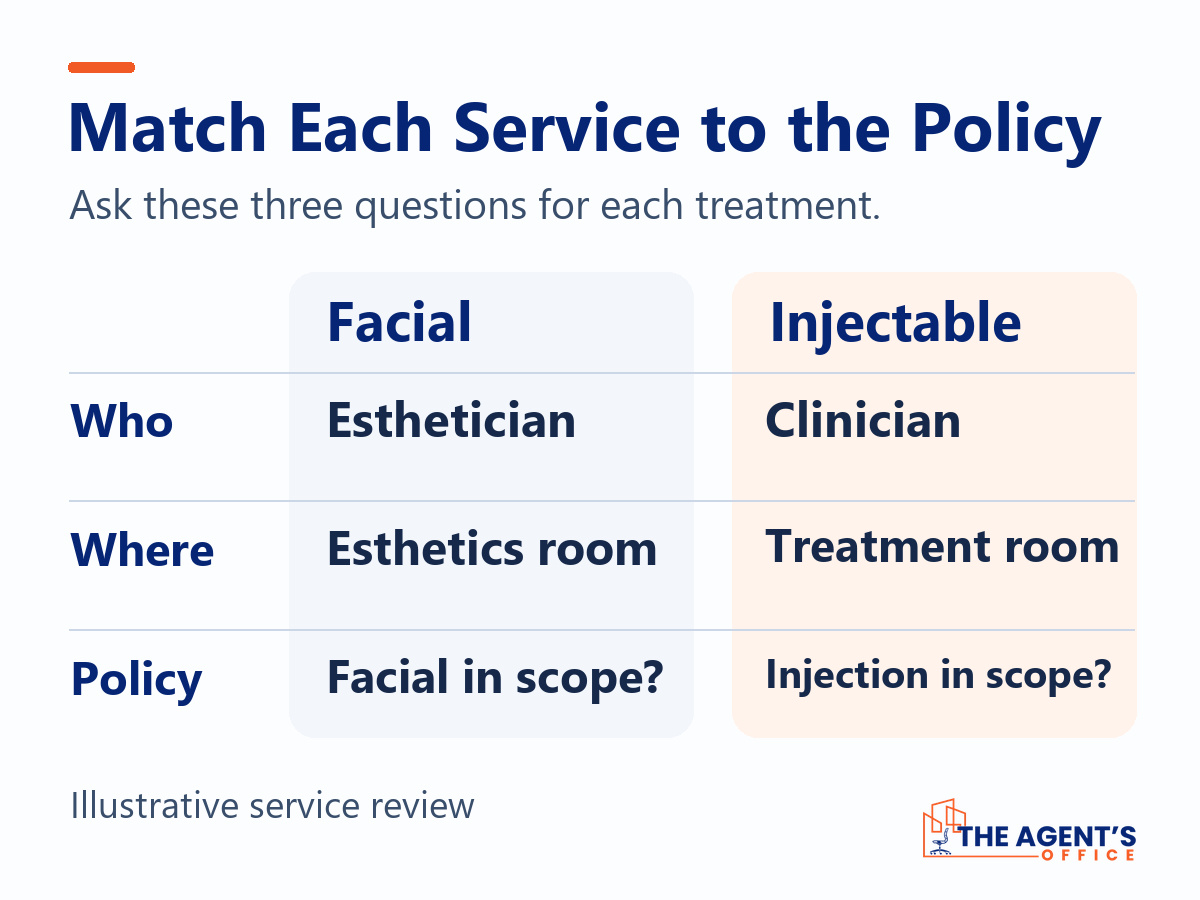
Imagine a med spa owner in Frisco reviewing a policy with her clinical lead before renewal. One side of the menu shows facials and waxing. The other lists injectables, and the owner is considering a peel at a second location. Whether that address is in Plano or McKinney, the starting question is the same. For each service, where does the issued policy tell you which work, people and locations are covered?
Proverbs 15:22 says, “Without counsel purposes are disappointed: but in the multitude of counsellors they are established.” (KJV) That counsel fits the owner’s next two conversations. Ask the appropriate Texas licensing or healthcare professional to review who may do the work and under what conditions. Ask the insurance professional to identify the policy language for that work. Put both answers in writing while there is time to resolve a question before the first appointment.
Where do facials, waxing and injectables fit in the policy?
Make one line per service and list the person who performs it, the business that offers it, and the address where it happens. Write “basic facial,” “facial waxing,” and “hyaluronic-acid filler,” if those match what you offer. A line item called “aesthetics” is too broad to tell an insurer what you actually do. Add the product or device when it changes what the service involves. Use the name the customer sees as a reference, then give the reviewer the underlying facts.
Next, give each line a place to point in the paperwork. Start with the declarations and forms list, then read the coverage grant, professional-services definition and applicable endorsements or exclusions. Look for any treatment schedule and ask whether listed services are exhaustive under the wording. Where the wording is broad, ask how it applies to the specific operation. Keep a separate column for open questions so a blank never reads as a confirmation.
Which liability coverage should I look at first?
An allegation about harm during a facial or waxing service calls for a review of the esthetic or other applicable professional liability wording. An allegation about how an injectable was selected or administered calls for review of medical professional liability. A visitor slipping near the front desk generally leads you to the premises question under commercial general liability. Allegations sometimes cross those lines, and insurers apply their own terms. The Texas Department of Insurance’s general liability guide and our malpractice versus general liability guide explain the types of coverage.
A program might coordinate these risks in one package. Two policies might also address them through separate forms and endorsements. Either arrangement calls for the same review. Identify whether each document addresses the spa, the clinician and the esthetician in the capacities in which they actually work. Check any location conditions. Then check how limits and exclusions apply across coverage parts. The number of policies alone tells you little about those details.
Which Texas rules change the questions you ask?
The Texas Department of Licensing and Regulation’s med spa guidance describes traditional esthetic services such as facials and temporary hair removal and explains that an esthetician performs regulated esthetic services at an appropriately licensed establishment. The med spa name or presence of a clinician does not settle the establishment-license question. On the insurance side, confirm that the named business, service and location agree with the operation described to the insurer.
TDLR distinguishes a light or superficial peel that acts on the epidermis from a medium or deep peel that penetrates living tissue and falls within medical practice. “Signature peel” could describe different work at different locations. Ask the qualified professionals responsible for the service to confirm its classification, and then give the insurance reviewer the precise service description. That lets the reviewer check whether a broad “facial” wording answers the actual question.
Botulinum toxin and filler injections are medical treatments. An esthetician license by itself does not authorize them. Where Texas’s physician-delegation rules apply, 22 TAC §169.26 sets general standards and §169.27 addresses the physician’s written orders. Ask who is responsible for ordering, performing and overseeing the proposed work and confirm with the relevant regulator or Texas healthcare counsel as needed. Our Texas medical director liability guide goes deeper into that relationship.
| Service | Texas question to verify | Policy evidence to request |
|---|---|---|
| Basic facial or temporary waxing | Is the work within the practitioner’s license at the establishment? | Esthetic professional services wording, insured role and location. |
| Light or superficial peel | Does the actual service fit TDLR’s distinction? | Peel-specific definition, limitation or exclusion, if any. |
| Medium or deep peel | Which medical scope and delegation rules apply? | Written description, medical services wording and any treatment endorsement. |
| Botulinum toxin or filler | Who handles the medical order, performance and supervision? | Procedure, product, provider and supervision wording relevant to the service. |
Use this table to organize questions for the appropriate licensing contact and insurance professional. It cannot classify a specific treatment from its marketing name or settle which insurer would respond.
Which documents can leave you with the wrong impression?
“The application listed it.”
A dated application is valuable evidence of what you presented to underwriting. Trace the answer through to the proposal and issued forms. If the application says “facials and fillers” and the issued forms describe the services differently, show the difference to the agent. Ask which provision addresses each service, whether a specific form needs to change and when that change would take effect. Keep the written answer with the version of the menu you submitted.
“The certificate shows the business is insured.”
A certificate can summarize information about a policy. The Texas Department of Insurance’s certificate guidance explains that the certificate cannot change coverage. Use the policy to check the named insured. If you operate under a DBA, confirm the legal business name and the role of any separate clinical entity. If an endorsement is relevant, ask for the issued endorsement and read its scope.
“The medical director already carries malpractice insurance.”
Ask whether that policy addresses the director’s actual work at your location. Also ask the insurer how the spa or clinical entity and the staff are treated. An individually insured clinician and an insured business are separate questions, as are your liability for another person’s conduct and that person’s own defense. A room renter, employee and independent injector can qualify differently depending on the wording. See the guide to MSOs, clinical practices and 1099 injectors for common structures and the documents to compare.
“General liability comes with the package.”
Read the professional-services definition and any professional-services exclusion or endorsement. A headline limit on the proposal does not show that treatment work is included. If someone slips while being helped off a procedure table, explain those facts rather than classifying the event as a lobby fall. The point is to send an accurate description to the appropriate insurer or insurers so they can apply the policy.
Before opening the calendar for a new service, finish the service description, confirm the people and place, check whether the insurer requires notice or a policy change, and obtain the written terms and effective date. File that record with the dated menu.
What do different allegations tell you about the policy review?
Suppose a customer reports scarring after a peel, a second customer later alleges a problem with an injection, and a visitor slips on a wet floor in the reception area. Those are three hypothetical reports. Each points to a different first question. The business should also check reporting duties promptly rather than waiting until it decides which policy ought to apply.
| Hypothetical report | First question to ask | Documents or terms to review |
|---|---|---|
| Skin injury after a peel | Which professional services wording addresses the peel as performed? | Service description, provider and location, exclusions, incident date and notice terms. |
| Injury alleged after a filler injection | Which policy and dates address the entity and treating clinician? | Medical professional liability, covered role and procedures, exclusions, retroactive date and reporting terms. |
| Visitor slips in the waiting area | Which premises terms address the facts at that location? | Commercial general liability, location and insured status, exclusions and notice terms. |
Key Findings (November 2026)
- Peel allegations. In a 2019 US review of 68 selected nonsurgical cosmetic cases found in two legal databases from 1985 onward, 94% of the 17 chemical-peel cases involved burn or scarring allegations attributed to inappropriate administration. When you describe the peel to the insurer, include enough detail to determine which wording addresses the actual service. The study describes selected disputes, without a denominator of treatments performed.
- Time from incident to filing. A 2026 study of 46 selected US filler litigation cases from 1967 to 2025 found a mean of 2.4 years between the incident and claim filing. This is a reason to ask about earlier work when changing insurance. It is neither a reporting deadline nor a prediction for any Texas practice.
- Provider changes. The American Med Spa Association’s 2024 US survey recap reported that 48% of med spas had hired a medical director in the preceding year. New openings were included. The finding identifies a practical review trigger for the practice and the new physician’s role. The public recap does not give a Texas breakdown or a coverage rate.
Which dates should go on your review sheet?
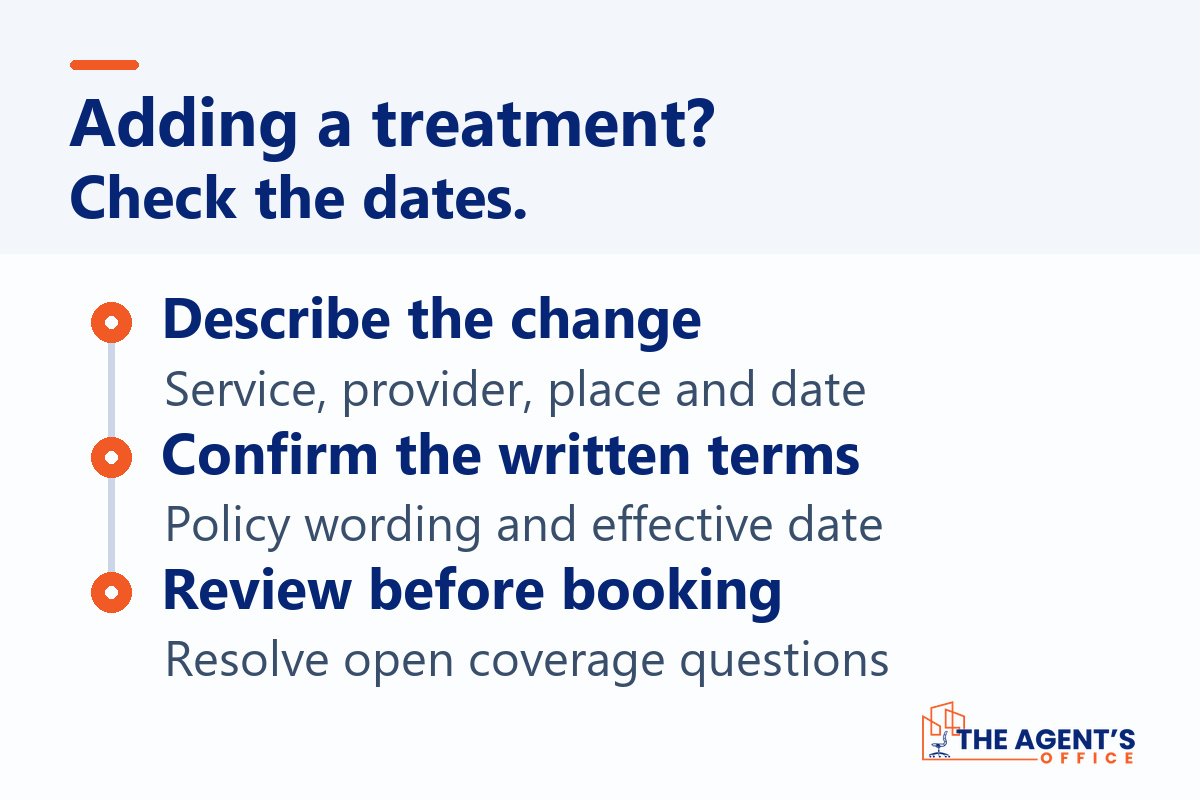
Separate the date the treatment begins from the effective date of any policy change. If the relevant professional coverage is claims-made, also check the retroactive date, when a claim is first made and when it has to be reported under your form. A new insurer’s prior-acts wording or an extended reporting period under the former policy may matter when switching. An extended reporting option generally concerns time to report eligible prior work. Check its exact conditions before relying on it. The TDI medical liability shopping guide walks through the general timing and continuity questions.
Then check limits and defense provisions alongside dates. Is there one aggregate for both categories? Does a particular treatment have its own limit or retention? Do eligible defense costs reduce the amount left to pay covered damages under the form? These questions also help when two proposals look alike on the premium page. Our med spa quote comparison guide shows how to compare those terms on the same facts.
What should I bring to a med spa coverage review?
YOUR REVIEW-PACKET BUILDER
Prepare one organized review packet.
Mark the document groups you have ready. Your packet keeps the remaining groups on a “still to gather” list and includes questions for your chosen situation.
A planning aid only. This tool does not upload documents or submit your selections. “Save on this device” remembers only your situation and checklist choices for this article. The printable download includes a Print / Save as PDF button.
PACKET PREVIEW
Your next conversation, organized.
Situation: Explore the full insurance guide
Marked ready
- No groups marked ready yet.
Still to gather
Questions to bring
- Which policy provisions address each procedure, business, provider and location?
- What services, products, duties or settings require additional review?
- What written change or effective date should we verify before the next booking?
Bring the dated menu and staff roster, declarations, forms list and endorsements, plus any written answers about proposed changes. Add the legal business names, DBAs and every location you want reviewed. For a new treatment, include the planned first appointment date and note the service, product or device, provider and clinical role. If a provider recently changed, include the dates and the work each person performs.
Ask the reviewer to identify each relevant policy and clarify what the wording says about the service, role, location and dates. Ask which points require an insurer’s written response, an endorsement or a separate placement. Mark which questions remain open. An owner should be able to find the page and form number again when the insurance renews or the service changes.
The Agent’s Office® can help you compare the operation you describe with the policy terms available for review. You can start with our med spa insurance service page or use the quote panel to send a general description of the practice. Keep identifiable patient details out of a quote request. If your next change involves a particular device, our RF microneedling coverage guide explains the additional device questions.
Follow The Agent’s Office® on Facebook for more insurance guidance for Texas practices.
YOUR NEXT STEP
Bring the coverage picture together.
Bring your current policy and planned service menu so The Agent’s Office® can help identify the coverage questions to resolve.
FAQs about Texas med spa insurance for facials and injectables
Can one program cover traditional facials and medical injectables?
It can, depending on the insurer, the issued forms and how the practice is set up. Check the applicable professional coverage parts for each service, entity, provider and location.
Does adding injectables to the menu require a new policy?
It depends on the current wording, underwriting and what your practice plans to do. Ask whether the service can be addressed by the existing form, a written endorsement or a separate policy. Confirm effective dates before booking.
Does a certificate prove insurance for waxing or facials?
A certificate cannot change what the policy covers. Use the issued policy, professional-services wording and applicable endorsements to evaluate the service.
Can my esthetician perform every peel on my menu?
Texas guidance distinguishes light superficial services from medium or deep peels. Confirm the actual technique, its regulatory classification and the practitioner’s authority with the appropriate professionals.
Does my injector’s individual policy cover my med spa?
That depends on the policy’s insured definitions, endorsements and allegations. Review which party is insured for which activity and whether the policy addresses its role.
How do I know when coverage changes for a newly added service?
Request written terms and the applicable effective date. If the form is claims-made, compare that date with the retroactive date and reporting terms to understand the treatment of prior work.
Where can I start a Texas med spa coverage review?
List current and proposed treatments, staff roles and locations, then gather your policy and endorsements. Use the quote panel to describe your practice and ask for a review.
Sources and references
- Texas Department of Licensing and Regulation, Medical Spas
- Texas Medical Board, Occupations Code and Board Rules
- 22 TAC §169.26, General Standards
- 22 TAC §169.27, Physician Responsibilities Related to Written Order
- Texas Department of Insurance, Commercial General Liability Insurance
- Texas Department of Insurance, Medical Liability Insurance Shopping Guide
- Texas Department of Insurance, Certificates of Insurance FAQ
- Medical Malpractice Claims After Nonsurgical Cosmetic Procedures, September 2019
- Le and Le, Litigating Filler Complications, August 2026
- American Med Spa Association, 2024 Medical Spa State of the Industry executive recap
- Proverbs 15:22, King James Version

ABOUT THE AUTHOR
George Azide
Founder & Principal, The Agent’s Office® · Frisco, Texas
George is the Founder of The Agent’s Office® in Frisco, Texas. As an independent agent, he specializes in translating complex insurance terms into clear, honest strategies for families and business owners. George helps clients across North Texas protect their income and assets through customized insurance solutions.
CONTINUE READING


