

MEDICAL PROFESSIONAL LIABILITY · TEXAS
CRNA Malpractice Insurance in Texas: 1099 Work, Costs and Tail Coverage
A practical way to compare the assignment, the people insured, policy limits and the reporting arrangements before the first shift.
TL;DR FOR BUSY PEOPLE
A 1099 label does not decide who insures a CRNA. The answer depends on the assignment contract and the actual policy provisions for insured people, services, locations, limits and dates. Before work begins, establish who must arrange coverage and who is responsible for an extended reporting period if a claims-made arrangement ends.
FAST ANSWER
- Does my employer’s insurance cover a separate shift? It may or may not. Check the policy’s insured-person definition, covered services, capacity and any outside-work restrictions.
- Does the surgery center’s limit cover me? Do not assume it does. Facility and clinician coverage can be arranged differently, with shared or separate limits depending on the issued policy.
- Who pays for tail? The applicable agreement and policy determine the obligation and available options. Settle the question before an assignment begins or an existing policy ends.
The extra shift comes with a second insurance question
Picture a hypothetical CRNA whose regular work is with a hospital group. A surgery center offers a separate contract for a day of anesthesia services. The schedule is set and credentials are being reviewed. The agreement says professional liability insurance will be provided, but it does not explain the insurer, the insured person, the work described in the policy or what happens when the assignment ends.
That handoff matters whether the work is in Frisco, Plano, McKinney or another Texas community. Our medical practice insurance resource explains the wider healthcare program; here the focus is the clinician’s particular assignment. This guide is educational. Coverage depends on the actual policy and facts, and legal, licensing and clinical questions should be reviewed with qualified professionals.
Who arranges coverage for a CRNA’s outside work?
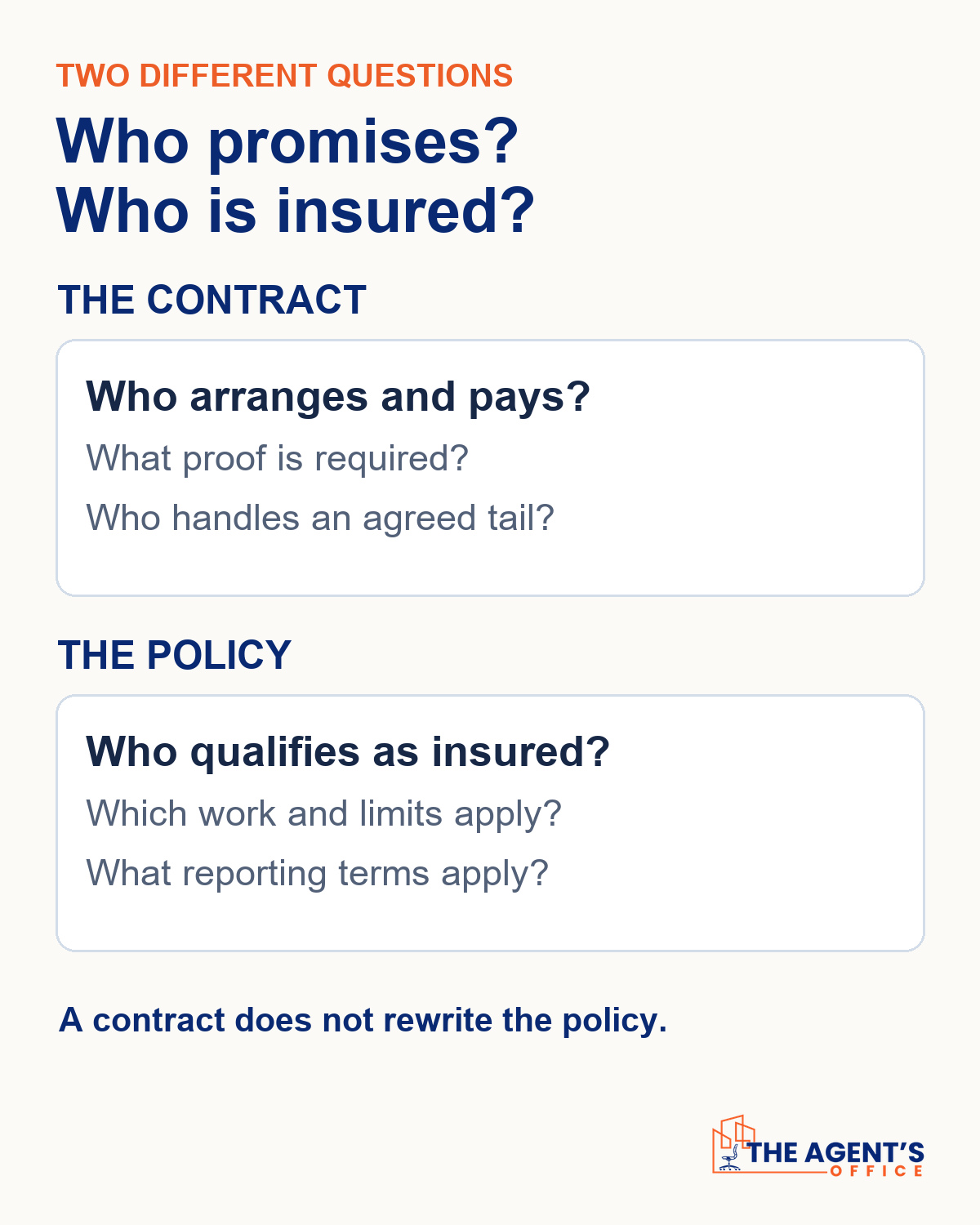
CRNA malpractice insurance addresses a different question from a contract. A service agreement can require a party to purchase insurance or provide evidence. The issued policy determines, subject to all its terms, which people and organizations qualify as insureds and which services, allegations and dates fall within the arrangement. A promise in one document does not rewrite the other.
A CRNA might rely on an individual policy, a group or employer arrangement, coverage arranged by a staffing organization, a facility program, or some combination. The right answer cannot be inferred from a tax form. Calling work “1099,” “locum” or “moonlighting” is a useful description for the conversation, but the label alone does not establish insured status, exclude a shift, or prove that a separate policy is necessary.
Begin with four questions: Who is insured? In what capacity? For which professional services and locations? During what period and under which reporting terms? Ask the insurer or the agent responsible for the policy to explain unclear wording, and obtain the relevant answer in writing. A clinician need not appear as a named insured on the declarations to qualify under every policy; some forms describe insureds by category. Conversely, a name on a certificate is not a substitute for the policy’s definition.
Before signing, ask for the complete insurance exhibit rather than relying only on a summary. Mark the effective dates, the legal names of the parties, the required limits and any departure provisions. If the staffing company arranges the insurance, identify the person who can provide the policy documents and explain how this particular assignment is included. If a facility requires a certificate, confirm who receives it and when an updated document is needed.
Then compare the actual scope of work with what was submitted for coverage. A change from one facility to another, additional procedures, a new business entity or a materially different schedule can raise questions that were absent from the original application. Tell the agent or insurer about changes and request an explanation of whether an endorsement or other action is needed. Keep the response with the assignment records.
A practical document handoff
On a phone, swipe across the table to see every column.
| Document or party | Question to resolve | Evidence to retain |
|---|---|---|
| Assignment agreement | Who agrees to arrange and pay for coverage and any required tail? | Signed agreement and insurance exhibit. |
| CRNA or clinician entity | Who qualifies as an insured, and for which services and locations? | Declarations, policy definitions, schedules and relevant endorsements. |
| Anesthesia group or staffing firm | Does its policy address this assignment and this clinician’s capacity? | Applicable forms and written clarification from the responsible insurer or agent. |
| Surgery center | Which policy addresses the facility’s own exposures and its relationship with clinicians? | Facility policy, contracts and any applicable endorsements. |
The table is a review map, not a finding that any party has or lacks coverage. Keep the version in force for each assignment and record the person who answered each open question. If a contract changes the facility, duties or dates, compare the changed facts with the documents again.
The Texas surgery center handoff: facility and clinician are separate questions
A surgery center and a CRNA can face different allegations arising from the same event. Their legal roles, insured status and policy provisions may differ. The center’s insurance might address its own operations, while a separate individual or group arrangement may address the clinician—or a particular program may use another structure. Read the actual policies rather than treating any one arrangement as automatic.
Ask the facility what its contract and credentialing process require. Clinical privileges, facility rules and insurance are related parts of an assignment, but they are not the same decision. Texas Health and Human Services provides information on ambulatory surgical center licensing; applicable clinical and regulatory requirements should be confirmed with the facility and qualified advisers.
Next, compare the policy’s professional-services definition and any schedules with the actual anesthesia work. A broad description in an email may not answer questions about location, specialty, patient population, supervisory or administrative duties, or services provided through a separate entity. Do not assume that a license to perform an activity is itself an insurance endorsement. Disclose the facts accurately and ask the appropriate insurer how its issued terms apply.
When more than one policy is involved, ask each responsible insurer or agent how its policy addresses the same assignment. Terms such as primary, excess and other insurance can affect how policies interact, but a certificate alone may not resolve the issue. Do not assume that purchasing another policy automatically increases the amount available for a claim or removes a condition in another contract. Compare the wording and obtain professional advice for the actual arrangement.
Also distinguish the facility’s required limits from a recommendation for your own needs. A contract can specify a minimum as a condition of an assignment; that number does not establish that a particular limit is adequate for every clinician or entity. Ask what the per-claim limit, aggregate, defense-cost treatment and any deductible mean together, and consider the financial and legal implications with the appropriate advisers.
Are the limits shared or separate?
A limit shown on a certificate is a starting point. Ask whether the amount applies per claim, in the aggregate, to several insureds together, or separately to a particular insured. Our definition of shared and separate medical liability limits explains the distinction. Ask whether defense costs are inside the available limit, outside it, or handled in another way under the form. Check any deductible or self-insured retention and who bears it. The answer depends on the policy, not the size of a number on a summary.
For a facility-side perspective, see our guide to temporary physician coverage at Texas surgery centers. It addresses a different clinician and audience, but the distinction between the facility’s obligations and the assigned professional’s insured status is useful for a CRNA handoff too.
Five assumptions that deserve a second look
- “My employer covers me, so every shift is covered.” Employer coverage may be limited by insured capacity, the entity on whose behalf services are rendered, the work performed or another provision. It may also extend to specified outside work. Ask for an answer tied to the actual assignment.
- “The surgery center has a policy, so I am included.” The center’s policy may protect the center and may or may not include the contracted clinician. Read the insured-person wording and endorsements rather than assuming either result.
- “The certificate is the policy.” A certificate summarizes selected information. The Texas Department of Insurance certificate FAQ explains limits on what a certificate can state and that copies of policies and endorsements may be provided. It does not change the underlying coverage.
- “My new policy automatically reaches my old shifts.” Prior-acts coverage, if provided, depends on the new policy’s retroactive date and other terms. Review continuity before canceling the earlier arrangement.
- “Tail is included, and someone else will pay for it.” An extended reporting period may be available, included or subject to purchase, conditions and deadlines. Determine the policy terms and the contractual responsibility for arranging and paying for it.
A distinction matters here: a gap in scope is not the same as a gap in time. If a policy does not include the clinician’s outside services, keeping it active longer may not cure the scope issue. If the services are within scope but a claims-made policy ends, the reporting provisions still need review. The two questions require separate answers.
If the assignment is through a clinician-owned business, identify both the individual and the entity. The legal name on an agreement, an invoice or a certificate does not automatically establish that every person or entity is insured. Ask which policy addresses each party’s role. The existing discussion of malpractice versus general liability also explains why professional services and premises exposures should not be treated as interchangeable.
Compare limits, costs and what happens after the policy ends
When asking about cost, give the agent enough information to compare the same work: professional role, procedures, practice locations, hours or other requested exposure measures, desired effective date, claims history, entity structure, limits and current coverage. An insurer may evaluate additional information. Premiums, eligibility and policy terms vary; a figure taken from an unrelated clinician or a different state is not a quote for your work.
Compare more than the first annual premium. Ask whether the quotation is occurrence or claims-made, what retroactive date applies, whether defense expenses affect limits, what deductible or retention applies, and what a change in work or reporting arrangement could cost. For claims-made coverage, request the current extended-reporting-period terms and a written estimate if one is available. Ask whether the insurer can change that estimate, what election deadline applies and whether any retirement or other provision has conditions. Do not assume a tail is free, required in every transition, or available in every policy.
For a fair price comparison, ask that each proposal describe the same professional role and work. A lower initial premium may reflect a different form, limit, deductible, scope, reporting arrangement or underwriting assumption. Request a side-by-side explanation of material differences and ask which costs might arise later. If a quote excludes an activity you expect to perform, raise that issue before treating the prices as comparable.
Keep a transition file when an assignment or relationship ends. Save the policy, declarations, endorsements, agreement, reporting instructions and written confirmation of any purchased extended reporting period or accepted prior acts. Record deadlines in your own calendar and identify a contact for questions. A document-retention habit does not establish coverage, but it can make it easier to understand which insurer should receive a later notice.
The Texas Department of Insurance medical liability shopping guide, last updated March 31, 2025, describes both tail coverage from an old insurer and prior-acts coverage from a new insurer as possible approaches when changing claims-made insurers. It cautions that tail can be expensive. Its general discussion is not a current Texas CRNA quote or a guarantee that either option is available for a particular assignment.
On a phone, swipe across the table to see every column.
| Arrangement | Question about earlier work | Departure review |
|---|---|---|
| Occurrence | Did the relevant event occur within the period and meet the policy’s other terms? | Retain the policy and reporting instructions; do not assume every later allegation is covered. |
| Claims-made with an applicable extended reporting period | Were the earlier services eligible under the old policy and does the later claim meet reporting conditions? | Confirm availability, election deadline, duration, cost and responsibility for arranging it. |
| New claims-made policy with accepted prior acts | Does the new policy’s retroactive date and wording reach the earlier work? | Obtain the actual prior-acts terms; do not assume they replace every benefit of a tail. |
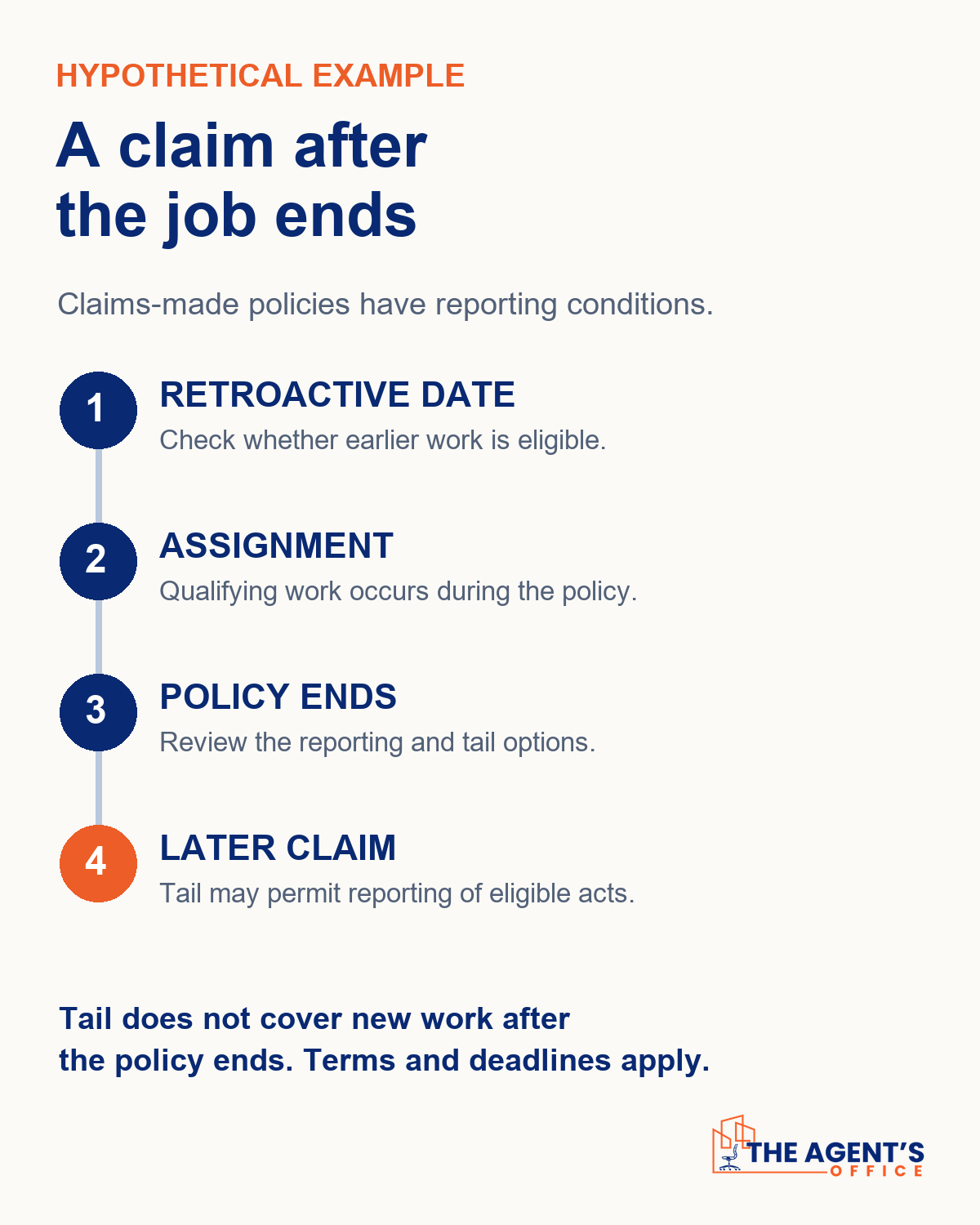
These are simplified educational comparisons. The policy’s precise trigger, definitions, exclusions, limits, reporting rules and facts determine the analysis. A tail generally extends the opportunity to report eligible claims for earlier acts; it does not turn a terminated policy into coverage for new professional work performed after it ends.
Who is responsible for tail?
There is no reliable answer without the documents. The agreement may allocate the purchase and cost to a CRNA, a group, a staffing firm or another party, and responsibilities can depend on the reason for termination or other conditions. Separately, the policy sets the available reporting options and any election conditions. A contract obligation is not proof that a tail was purchased. Ask who will provide evidence, by when, and what happens if the insurer offers prior acts instead. An attorney can advise on the contract; the insurer or licensed agent can explain the policy.
As an explicitly hypothetical example, a claims-made policy addresses a CRNA’s qualifying work during an assignment and then ends. Months later, a claim concerning that earlier work is first made. An applicable extended reporting period might permit reporting under the old policy if its conditions are met. A new policy with accepted prior acts could be another arrangement, but its own terms and dates must be examined. Neither example predicts an insurer’s response.
For more detail, review our physician guide to claims-made and tail coverage and the explanation of malpractice retroactive dates. They are general explanations; the particular CRNA policy controls.
KEY FINDINGS (NOVEMBER 2026)
- A 2015 AANA Foundation analysis of 245 closed claims spanning 2003–2012 reported a median payment of $299,810 for its major permanent injury classification. This is historical, selected national closed-claims data—not a Texas CRNA premium, a prediction of an individual claim or a current average for all cases. Source: PubMed abstract.
- What limits were reported in a CRNA claims sample? The same 2015 analysis described most CRNA providers in its selected 2003–2012 claims as independent contractors with $1 million/$3 million malpractice limits. That historical sample does not establish today’s Texas market, an adequate limit, or a requirement for your assignment. Source: AANA study abstract.
- Why review reporting after an assignment ends? A 2020 study of 63 closed ophthalmic anesthesia-related claims against one insurer’s ophthalmologists, practices and surgery centers from 2008–2018 reported a range of 1 to 832 days from the event to opening a claim. This is a selected national ophthalmic sample, not a CRNA-specific or Texas estimate, a legal deadline or a recommended tail duration. The article’s narrative and table report different averages, so the consistent range is used here. Source: Morley and colleagues.
Prepare a useful coverage conversation
Before requesting a comparison, gather the contract and insurance exhibit, current declarations and policy forms, relevant endorsements, the name of each facility or group, a description of the professional services, the expected schedule and any requested loss information. If a policy is claims-made, locate its retroactive date and ask for the current reporting and extended-reporting terms. It is reasonable to start with what you have and identify what still needs to be obtained.
As an independent agency in Frisco, The Agent’s Office® can help organize your assignment details, discuss the available documents and seek options for the facts submitted. The appropriate market and any proposal depend on underwriting, and an agent cannot promise that a particular insurer will accept a risk or that a claim will be covered.
Bring any written facility limit requirements and questions about a clinician-owned entity. Ask the agent to explain what a proposal does and does not address, including important exclusions, limits, deductibles and conditions. Eligibility, insurer interest, price and the final policy depend on the submitted facts and the insurer’s decision. Requesting a quote does not bind coverage.
Proverbs 27:12 (KJV) says, “A prudent man foreseeth the evil, and hideth himself; but the simple pass on, and are punished.” Here the lesson is thoughtful preparation: ask the questions while there is time to understand the documents. A claim is an allegation, not proof of an error, and a verse is not evidence of a policy outcome.
For more Texas coverage discussions, like The Agent’s Office® on Facebook. If the assignment or facility changes later, revisit the review with the professionals responsible for the coverage.
Ready to review your CRNA coverage questions?
Bring the assignment details and the documents you have. We can discuss the information needed for a potential quote and review.
FAQs about CRNA malpractice insurance in Texas
Does a 1099 CRNA always need a separate policy?
Not necessarily. Determine whether an applicable individual, group, staffing or facility policy includes the clinician, work, location and dates. The contract and actual policy terms matter.
Does employer malpractice insurance cover moonlighting?
It may or may not. Review the insured-person definition, professional-services wording, capacity, location, exclusions and endorsements for the outside work.
Who pays for tail coverage when a CRNA leaves?
The answer depends on the agreement and applicable policy. Review who must arrange and pay for any required extended reporting period, its availability, duration and election deadline.
Can prior-acts coverage replace tail?
It may address some earlier work when the new insurer accepts it, but the retroactive date, covered services, exclusions, reporting provisions and other terms must be compared with the old policy and available tail.
How much does CRNA malpractice insurance cost in Texas?
There is no single reliable price for every CRNA. An actual quote depends on the insurer, work, locations, limits, policy form, history and other underwriting details. Ask about any separate tail cost and conditions.
You might also like:

Locum Tenens Malpractice Insurance for Texas Surgery Centers
How a facility can review a temporary physician’s coverage handoff.

Claims-Made vs. Occurrence and Tail Coverage
Understand the reporting and transition questions.

Malpractice Retroactive Dates
See why an earlier date can matter when coverage changes.

George Azide
LOCAL, INDEPENDENT AGENCY
Want a smarter quote?